Chris At The Pictures: horror
Showing posts with label horror. Show all posts

Saturday, 20 October 2018

'The Streaming Pile' - October 2018

10/20/2018 10:31:00 am 0
'The Streaming Pile' - October 2018


Welcome to this first edition of The Streaming Pile; my excuse to use a good pun thinly disguised as a monthly column discussing the latest crop of Netflix', er, 'cinematic' content. This month saw the release of three fairly high-profile films (as opposed to the usual strain of Friday night horror dreck): Operation Finale, 22 July, and Apostle.

Chris Weitz (directing for the first time since 2011's A Better Life) oversees Operation Finale, a historical thriller detailing the hunt for Nazi war criminal and architect of the "Final Solution", Adolph Eichmann (Ben Kingsley). On his trail is Oscar Isaac as Mossad agent Peter Malkin. Malkin tracks Eichmann to Buenos Aires, but complications arise when he and his team must secure their prisoner's signature, to officiate his appearance before a court in Israel. 


The scenes between Isaac and Kingsley are - as one would expect from two of Hollywood's finest presences - riveting, and there's certainly thrills (however scattershot) to be had in the Argo-like mission to capture Eichmann. The supporting cast are - perhaps as a result of having to square up to the two leads - somewhat less engaging, and the casting of American comedy staple Nick Kroll as one of Malkin's subordinates is more distraction than revelation. 


Also, the moral conflicts presented by Eichmann as an attempt to throw Malkin off his game feel thin and half-baked, and are almost immediately disregarded by the viewer because (thanks to seven decades of hindsight) we know him to be a cruel, deceitful manipulator. Nevertheless, it's a largely gripping race to the finish with a sublimely righteous coda.


Far less successful (and efficiently constructed in all the wrong ways) is Paul Greengrass' 22 July, which details the events and aftermath of far-right Anders Breivik's attack on a government building and a Workers' Youth League summer camp in 2011.


Greengrass begins with a well-detailed re-enactment of the atrocities, then following both Breivik's internment and one of his victims, Viljar Hanssen (Jonas Strand Gravli). And it's that latter half (largely centred on the all-too engaging Anders Danielsen Lie as Breivik) that presents a problem: this is one instance where the United 93 director's even-handed, tell-both-sides cadence is unsuccessful at best, and abject moral cowardice at worst. 


Its frame is cold, its focus is askew, and fails to make any real statement beyond 'this is what happened'. When it comes to showcasing such appalling acts of violence, taking a detached standpoint is precisely why monsters continue to rise in Breivik's stead, because cinema (and the media as whole) continue to give his ideologies as much air - if not more - than the voices of his victims. Simply presenting a competent, functional thriller-drama - as Greengrass does here - is not enough anymore.


Gareth Evans' Apostle, too, contains no deeper message, meaning, or political persuasion...and is all the better for it. In stark contrast to the timid Welshman's previous efforts - high-octane martial arts duo The Raid and The Raid 2 - this slow-burn chiller takes its cue from classical British horrors like The Wicker Man and Witchfinder General. Dan Stevens (who, for this writer's money, doesn't appear in enough movies) stars as a tortured traveller, bound for a remote island in search of his kidnapped sister. 


The tiny isle is the home of a religious cult under the sway of Michael Sheen's rabid preacher, Malcolm. Stevens' character, by virtue of existing in the early 1900s, has never seen a film before and hence doesn't run a mile when confronted with the aforementioned premise and it's connotations. Thus, he's caught off-guard when the eerie power of the island and Malcolm's religious fervour take a darker turn.

What happens next is best left unspoiled, but rest assured that fans of The Raid films (who might find themselves on uncertain turf here) will be more than sated by the final act. Their salvation is signalled by the moment when someone has their leg broken from under them while another takes a spear through the face: "There he is! There's our Gareth!"


Operation Finale, 22 July and Apostle are now available to stream on Netflix in the UK.

Sunday, 22 April 2018

‘Truth or Dare’ - Review

4/22/2018 09:15:00 pm 0
‘Truth or Dare’ - Review

½

From Blumhouse, the producers of Paranormal Activity and Get Out, comes this teen horror-thriller with neither the franchise potential of the former, satirical edge of the latter, or scare factor of either. Our generic band of college kids (living in their ludicrously fancy accommodation and kitted our with every fruit-based device at their disposal) are partying in Mexico for Spring Beak when a mysterious stranger (who they can definitely trust because he’s the right kind of rugged) involves them in a game of truth or dare. When the teens return home, they find the game has followed them, their nearest and dearest briefly transforming into hideous pursuers who urge their victims to reveal dark secrets or perform dangerous acts.

There’s nothing inherently wrong with this premise: many genre movies have been built on far less a stable foundation than a drinking game. It’s the flat execution and shrill performances that crush this unpopped kernel of potential fun. By-the-numbers doesn’t even begin to cover the construction. All together now: cast of idiot teenagers do something stupid. Something weird happens to one but they neglect to tell the others. Twenty minutes are spent fruitlessly trying to get us invested in their plight (a little personal bias comes in here, as the jock character closely resembles a childhood bully of mine). Everything goes very wrong and then there’s a stupid ending (credit where it’s due: there’s no final frame jump-scare).

For all the various crises - read: daddy issues - of our cast (such as a closeted student forced to out himself to a homophobic father or a habitual cheater dealing with her father’s recent suicide), I found myself cold to their plight. Largely because of their entirely plot-driven idiocy, but also because the methods used to dispatch them once the premise collapses and truth or dare become interchangeable are (with the exception of a crafty rooftop vodka binge) so blunt and bloodless. One supposes this comes part and parcel with production values of an episode of Riverdale, where prosthetics and make-up is made unaffordable by hugely unimpressive CG work. The sign of demon possession is little more than a Trollface Snapchat filter, an insult actually levelled by the protagonists towards their tormenters in a cynical attempt by the filmmakers to sidestep criticism. I dare Blumhouse to do better.

Friday, 29 September 2017

'Flatliners' - Review

9/29/2017 09:39:00 pm 0
'Flatliners' - Review

★ ½ ☆ ☆ ☆

In a revelation as inevitable as the “dead on arrival” gags accompanying its reviews, this sequel to Joel Schumacher’s 1990 thriller is as pointless as it is sterile. Five medical students become obsessed with triggering their own near-deaths in attempts to capture evidence of the afterlife. After initial highs and cognitive awakenings, the group find themselves hunted by the ghosts of their individual pasts.

The post-flatline powers exhibit themselves in trust fund hunk Jamie (James Norton) as increased proficiency in medical practices, whilst in the three lead women (Ellen Page, Nina Dobrev and Kiersey Clemons) as a sudden desire to get into Jamie and Ray's (Diego Luna) pants. Though they each have their own unique traumas to shape the apparitions, increasingly tiresome jump-scares and dark corridors morph them all into interchangeable quivering wrecks by the end. Courtney (Page) at least has some of her character fleshed out (the opening sequence clues us into the revelation she withholds from her peers, so they’ll indulge her experiment), but it’s all for nothing come the final act.

Luna plays the token sceptic, and is immediately engaging to the point that he almost pulls the whole enterprise together, though his hairstyle (perhaps in unspoken homage to the original’s fabulous array of wild wigs) is a choice almost as poor as his recent decision to work with Woody Allen.

A more befuddling decision is made by the filmmakers to include Kiefer Sutherland, reprising his role from the original as the students’ mentor. Again, it’s all for naught: never does he factor into their decision to explore flatlining, investigate them, or even deliver a knowing sermon. It’s the screenwriters showing they care enough to draw Sutherland back, but not quite enough to give him anything to do, nor to provide any other tangible connections to the first film, narratively or visually. Religious imagery and reveries make way for insipid sob stories, and the smoky streets and dark architecture are swapped out for crisp surfaces and vapid digital backdrops.

All this heavy comparison might fool you into thinking I hold the first Flatliners in high esteem. For the record; I don’t. Any interesting concepts are rapidly overridden by hammy performances and Schumacher’s total reliance on imagery over intelligence. This new iteration can barely pretend to offer the former, exhibiting drama as slack as its characters, living or dead.

Wednesday, 13 September 2017

'The Limehouse Golem' - Review

9/13/2017 09:35:00 pm 0
'The Limehouse Golem' - Review

★ ★ ★ ½ ☆

Here’s a deliciously sordid and gory gem from director Juan Carlos Medina and screenwriter Jane Goldman (Kick Ass, X-Men: Days of Future Past). Based on Peter Ackroyd’s book, Dan Leno and The Limehouse Golem, Medina’s film stars Bill Nighy as Inspector John Kildare. Eager to restore his reputation after damaging rumours of not being “the marrying kind”, Kildare is given the case of the titular Golem, a moniker appropriated by a killer who stalks the streets of London.

Olivia Cooke plays Lizzie Cree, a suspect in the death of her husband John (Sam Reid), himself under investigation for a possible part in the Golem murders. The alleged perpetrators have been whittled down to four: Cree, scholar George Gissing, stage performer Dan Leno, and Karl Marx (yes, that one).

During their individual questioning, we’re treated to fantasy sequences of each suspect committing one of the horrific homicides. Stylistic merits aside, they’re a hoot purely for the spectacle of Karl Mark dismembering someone with childish glee.

Each interviewee leaves an impression, but none more so than Douglas Booth as the exuberant Leno, who leaves no scenery unchewed. Eddie Marsan also puts in a juicy turn from under a very unconvincing bald cap, a prop which – combined with murky CG and an invisible but extremely loud orchestra in the music hall scenes – brings the film’s modest budget to the forefront.

Cooke is the best of the bunch by far, overshadowing even Nighy. Though reliably strong in his role as the noble and empathetic detective, the veteran British actor appears lost occasionally; the murder-mystery plot writ large over every inch of the marketing only rearing its head every once in a while. For most of the running time we’re taking trips back into Lizzie’s past, exploring her humble origins and deteriorating relationship with her husband and the stage she so desperately loves. Cooke proves a great companion for the journey, even if it’s genuinely painful turns feel somewhat at odds with the pulpier moments of misty streets and shameless viscera.

To its credit, the film itself seems aware of this imbalance. Infuriated by Kildare’s infatuation with Lizzie’s predicament, policeman George Flood (a great but misspent Daniel Mays) proclaims his confusion “as to whether we’re here to find the golem or save Elizabeth Cree!”

The unravelling revelations surrounding Lizzie’s guilt (or lack thereof) means Goldman can briefly raise a few discussions concerning the perceived innocence of one gender over another and the act of preserving one’s work after death. They’re piecemeal offerings, but to have them handed over by a B-movie Victorian horror is a welcome surprise. It’s not quite the ‘Hammer Horror takes on Mr Holmes’ we’re led to expect, but it’s well-acted, effectively gruesome and engagingly labyrinthine. Just one question: following Pride and now The Limehouse Golem, what film can we expect to complete the Gay Bill Nighy trilogy?

Monday, 15 May 2017

'Alien: Covenant' - Review

5/15/2017 01:08:00 pm
'Alien: Covenant' - Review

★ ★ ★  

Ridley Scott loses the plot somewhat in this bold and barmy return to the Alien franchise. Ten years on from the disappearance of the Prometheus, a colonization ship intercepts a transmission from the missing crew. Acting Captain Oram (Billy Crudup) makes a beeline for its point of origin, against the express wishes of terraforming commander Daniels (Katherine Waterston). Upon landing, the colonists encounter a long-derelict spacecraft, a deadly pathogen and a single living soul: the android, David (Michael Fassbender), last apparent survivor of the Prometheus mission.

A far cry from the doomed optimism of Prometheus, the tone here is one of heavy portent. The colours are a grey wash, smiles are rarely cracked, and the narrative plunges a downward spiral to oblivion. Covenant has the chutzpah to pick up from its 2012 predecessor in narrative form, but the inclusion of Alien in the title and marketing shackles it to the franchise, and not always for the best.

It’s a viscous, bulging sac of visionary ideas struggling to burst forth from a largely uninspired narrative. Stop me if you’ve heard this one: shipmates woken early, a distress signal found, one wrecked spaceship, several minutes of screaming  (and a partridge in a pear tree). After the lukewarm, and even hostile, response to Prometheus, it feels like Scott had to make certain concessions before Fox gave the reins back, hence why every horrific moment or action pulse-pounder feels like an ‘in your own words’ answer to an Alien trivia exam (Jerry Goldsmith’s original music cues are brandished too, with the slyest of grins).

However, Scott still gets his own way: the viscera is unabashed and grotesque (H.R. Giger would be proud), the special effects and visuals are slick, and there’s a generous helping of weirdness the likes of which we haven’t seen since Blade Runner. His opus is referred to throughout, in small dialogue notes (“That’s the spirit!”) and the many exchanges between David and the colonists’ own doppelganger robot, Walter. Doctor Tyrell’s “More human than human” echoed endlessly in my head as the two examined, probed and prodded each other. Fassbender proves his mastery once more by giving both roles distinct idiosyncrasies and literally creating sexual tension with himself.

Not all of it works. The literature-heavy screenplay and po-faced discussions about the nature of artificial intelligence grate just occasionally, with some audience members giggling outright. The same derision was also aimed at the human characters’ casual approach to alien eggs and dark rooms, a staple of the franchise now wearing thin. I didn’t care one jot about the colonists, either. I have a sneaking suspicion we’re not really supposed to, but if that’s the case, why are there so many of them? Waterston and Crudup proved more than capable exceptions to my apathy (the former especially), but they’re side-lined in favour of everything else rolling about in this great tumble-drier of a film.


It’s predictable and overstuffed; a rush to connect this set of prequels with the original films that simultaneously takes too long to get going and sprints to the finish line, stomping inconsistencies into the ground in its wake. And yet, I’d argue Covenant is worth the sore feet. Scott remains an interesting case of authorship in Hollywood, and his dedication to religious themes and future prediction is as unshaken as ever… if only he could only find a way to balance them better with the xenomorph zealotry we all know and love.

Friday, 14 April 2017

'Life' - Review

4/14/2017 04:08:00 pm
'Life' - Review

★ ★ ★  

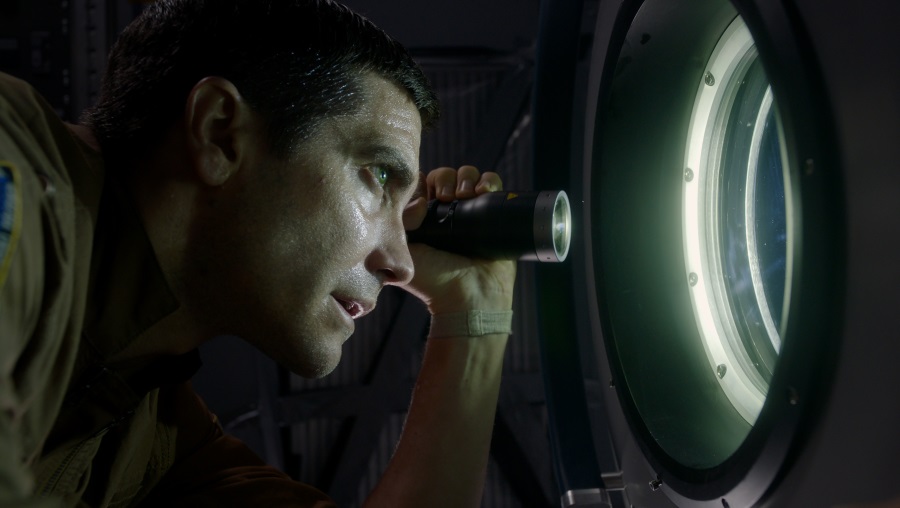
Jake Gyllenhaal returns to B-movie cinema in this weightless but efficiently gruesome space creepie. A team of astronauts and scientists on the International Space Station are thrilled when a probe dispatched to Mars returns laden with samples, one of which could demonstrate proof of life on the red planet. One such sample contains a miniscule but motionless organism. Being characters in a creature feature, they inevitably decide to inject it with nutrients, poke it with an electrical prod, and generally fiddle about in a way that can only lead to much yelling and crunching.

With the creature loose on the station, the film becomes an episodic series of chase sequences intercut with light musings on the nature of life, as the various inhabitants of the ISS (Gyllenhaal, Ryan Reynolds, Rebecca Ferguson et al) attempt to prevent ‘Calvin’ from reaching Earth.

With the basic premise and top-of-the-line visual effects taken into consideration, yes, it’s little more than Alien and Gravity blended together…but the resulting milkshake goes down well with a large popcorn. Gyllenhaal brings his A-game, even to what may seem a step down from his recent string of varied, comparatively arthouse roles, and Ferguson continues to build on a promise of stardom. Reynolds is rather less impressive, but for plot reasons as opposed to lack of ability. Hiroyuki Sanada (as in Sunshine, playing an awestruck astronaut who can’t catch a break) never gives a bad performance, and is suitably intense.

In short, they’re all good company when Calvin gets bored of them all moping about the Challenger disaster (a huge misstep in an otherwise amiable script) and decides to start separating various limbs and vital organs from their bodies. The creature is an effectively creepy amalgamation of several we’ve seen before and the gore is visceral and plentiful: picture the grisliest bits of Prometheus and you’re in the right ball park.


I really want to talk about the ending – because it’s the one part of the film that draws out anything more than a plaintive “Yeugh!” or shrill gasp – but all I can say without dropping spoilers is that you’ll never find a more jarring use of Norman Greenbaum’s Spirit in the Sky. It’s like tacking Peter Genesis’ Carpet Crawlers onto the epilogue of The Fly. Again, I’m referring to another piece of sci-fi because there’s barely a microbe of original thought present in Life. But that's not a slight: it’s schlocky and slimy and all kinds of stupid… and I had a ball with it.

Wednesday, 22 March 2017

'Get Out' - Review

3/22/2017 11:45:00 pm
'Get Out' - Review

★ ★ ★ ★ 

Jordan Peele’s directorial debut isn’t titled I’m not racist, I have black friends: The Movie, but it may as well be. The film sees photographer Chris (Daniel Kaluuya) visiting the affluent family of his girlfriend, Rose (Allison Williams), unsure as to how they’ll react to the news that he is, in fact, black. Against the urging of his best friend, Rod (LilRel Howery, who delivers a landslide of the film’s comedic joys), Chris puts on a brave face and makes the trip. Upon arrival, the cringeworthy greeting from Rose’s parents (Bradley Whitford and Catherine Keener) establishes an atmosphere of awkwardness that could so easily be dismissed as over-friendliness, but amounts to something far more sinister.

From the instant we’re introduced to the Armitage household, with its two black servants and immaculate displays of courtesy, Peele slashes the veneer to allow scalding satire to bleed through. There are comments on cultural appropriation (Roses’s father, Dean, proudly shows off his myriad of multicultural objects that now amount to little more than mantelpiece trinkets), the usually glossed -over smugness of liberal racism (Dean’s over-emphatic oath that he would have voted for Obama for a third term, given the chance) and the fetishising of black bodies. Rose’s extended family gawk at, poke and fawn over Chris’ physical form. “Is it better?” one of the women asks, slipping Rose a knowing look, while a genial uncle declares “Fair skin is out – black is back in fashion!”

No, these aren’t your usual cackling, toothless hicks who readily admit to their backward views with glee; wine takes the place of moonshine, slack-jawed grimaces swapped for painted smiles. In fact, they’d probably rush to tell you how much they “simply loved Get Out. Even at the most jaw-dropping, unutterable moment of discriminatory revelation, Stephen Root’s blind art dealer decries any inherent racism, before immediately explaining his motivation in a way that can only label him so.

I’m hesitant to co-opt a review about a film primarily concerned with racism and cultural satire to gush about its genre trappings, but considering the rut that studio horror has dropped into recently, we’d best appreciate what Peele has gifted us here. When was the last time a multiplex horror drew on something like Invasion of the Body Snatchers for more than cheap nods to horror nerds? There are contemporary comparisons to make, too: an early scene projects the suffocating depths of Under the Skin through the most famous visual cue from Trainspotting. Oh, and it’s got actual cinematography, not just a greyscale frame left empty in preparation for jump scares!


Cattle-prod frights do appear, but incorporated into a general aura of skin-prickling unease that only intensifies as Chris discovers what lies beneath. And, God, is it a thrill. The steadily-rising dread delivers on every promise the critical hype machine could possibly spit at you, from a supremely unnerving cold open to a conclusion that’ll leave nail marks in your palms for weeks. There are so many moments worth gushing over, but my aversion to spoilers and usual failure to adequately explain a plot means I won’t do that here. All you really need to know is that it’s smart, sharp, scary and everyone in it is sublime (with particular emphasis on Kaluuya, Williams and Keener). How many more great films can 2017 throw at us before we’re exhausted? One more, it seems.

Tuesday, 7 March 2017

'Logan' - Review

3/07/2017 03:23:00 pm
'Logan' - Review

★ ★ ★ ★ 

Hugh Jackman lays claim to the Wolverine character once and for all in this dark and edgy superhero spin-off. In a future where the other X-Men have long-since disappeared, Logan/Wolverine lives as a chauffeur across the Mexican border by night and cares for the mentally-damaged Charles Xavier (Patrick Stewart) by day. Their isolated existence is shattered when a desperate woman entrusts Logan with helping a young girl, Laura (newcomer Dafne Keen) escape sinister forces. What follows is less a special effects blockbuster than a gritty, bloody road movie, as the increasingly fraught Wolverine is forced to face uncomfortable truths about his legacy.

Most of us take Hugh Jackman’s most famous role for granted, but his six foot-plus, ever-vested physique and inescapable charisma have been a constant sticking point for fans of the original comic version: a stocky, lycra-suited potty-mouth. Logan is the first film to really take these differences into account, and even make amends: whilst Wolverine vehemently denies any truth to be found in Laura’s collection of X-Men comics, there’s easily enough money in his swear box to fix several church roofs. It helps that Jackman’s own dedication to portraying the character has never once wavered, and continues to enthral. As sad at it is to see him finally let Logan go, it’s a fantastically well-pitched goodbye.

In the aftermath of Deadpool, the “we need more R-rated superhero movies” declaration has been bandied about a lot with very little thought, but director James Mangold (paying reparations for his comparatively tame and uninteresting The Wolverine) actually uses it appropriately. The first spoken word of the film is a sharply-uttered f-bomb; a display of aged irritation, not an immature opportunity to curse. A 15 certificate does allow the film to breathe with the foulest of mouths, but also to consider themes of aging and death without alienating a younger audience. It’s difficult to imagine subtle details such as Wolverine’s arthritic claws, limp, permanent scars and dusty grey hair making it into the final cut of a glossy Bryan Singer or Matthew Vaughn production.

Oh, and it’s very, very violent. Wolvie’s rages have been the bloodiest staple of the franchise from the beginning, but here they finally mean something again. Every chest cavity ruptured, every decapitation, every maimed limb may as well add five years to Logan’s already extended life-span. For the first time, you look past the physical regeneration to the mental degradation. George Stevens’ Shane is unsubtly alluded to throughout – “There’s no living with the killing” – but it’s a well-intentioned nod that brings some levity, just as the gore is shocking but not without some sense of entertainment (particularly during an early display of Laura’s own powers).

Keen will certainly be one to watch. At first she appears to be contributing a very run-of-the-mill silent, staring child performance, but when the plot kicks into high-gear, the intensity she displays is truly remarkable. Stephen Merchant brings the weirdness of the older ­X-Men films as an albino mutant-finder, Caliban. References to Merchant’s “goggle-eyed” appearance might have begun as a long-running gag on the XFM show he used to host with Ricky Gervais, but his particular features and sarcastic intonations are a great fit, providing stark contrast to Logan’s introspective glowering and Xavier’s incoherent, rambling regrets.

That the film is so deliberately vague with regard to Xavier’s troubled recent history pays dividends: there’s little explanation about what happened to the other mutants, what state the wider world is in (our only indication here is empty backdrops and stricter border controls), or what the ‘Westchester Incident’ refers to. All we really know is that Xavier’s degenerating telepathic mind is now considered a weapon of mass destruction, which is itself enough to spark our intrigue and fear.


My social media feed this week has been full of people ranking Logan alongside previous X-Men films, but it seems weird to do so considering just how different it is. Subplots are almost exposition-free, visual effects are used sparingly, and even the cinematography and production design feel less machine-tooled. It’s a grimy, hyper-violent thriller; a toeing of the genre line (far more so than Deadpool’s already outdated in-jokes) that stands alone, and ends on the most perfect note imaginable.

Thursday, 9 February 2017

'Rings' - Review

2/09/2017 09:20:00 pm
'Rings' - Review

★ ½ ☆ ☆ 

The most immersive moment in Rings – a resurrection of the killer VHS saga – came when the DCP from which the film was projected cut off, just for an instant. In that deathly still second, it was almost as if the jittery, unstable nature of the series’ cursed videotape had infected the cinema itself. But then sight and sound returned, and my sudden immersion was shattered by Vincent D’Onofiro’s blind priest bellowing so loudly that the scenery he’d been previously chewing flew from between his teeth and spattered the camera lens.

Besides the basic premise (you watch a weird videotape, you die seven days later), my experience with this franchise is limited to watching Gore Verbinski’s The Ring with several drunk friends who shouted “Non, Gaston!” when Martin Henderson’s character died (I have no idea why, either), and one of the two funny jokes in Scary Movie 3. Just Google ‘Scary Movie 3 nah I'm just screwing with ya’ and you’ll find the clip, and – by awful, unbelievable extension – spoil the ending of Rings for yourself.

In this long-gestating instalment, attractive young couple Julia (Matilda Lutz) and Holt (Alex Roe) are drawn into the dark world of Samara’s curse by Gabriel (Johnny Galecki) and his obsession with the tape, which leads the two on a search for the ghostly girl’s resting place. After some initial and not entirely unexpected VHS fetishism, the original video goes digital…because apparently smartphones and e-mail are the ‘hip’ thing for horror now.

I watched Rings following my fourth viewing of Rogue One (leave me alone), and D’Onofrio’s hammy madman is something of an amalgamation of characters from the preceding film: a sightless religious man blessed with near-supernatural powers also inherits Forest Whitaker’s prestige beard. The fact my brain even made this connection is probably an indication that I wasn’t that involved in the film, but, then again, none of the actors seemed to be, either. I suppose it’s hard to feign interest in playing the same old horror archetypes that wore out their welcome even before the first incarnation of the Ringu legend hit screens in 1998.

The closest resemblance this bears to previous episodes is stylistically; by which I mean it looks and sounds like a schlocky genre film from early 2000s. There’s a peppering of fairly smart editing, the lighting leans heavily on various shades of green and black, and there’s a piano and string score to lend a cinematic feel that most modern horrors would ditch.

What a shame that more signifiers of the current found-footage era weren’t left by the wayside. I could maybe forgive the university students being played by people obviously in their late twenties, or the bit where it turns into Don’t Breathe for two minutes. But the boring camerawork, shoddy attempts at tension building and frightening moments notable only by their absence are a chore to sit through. Plus (and I know this isn’t his fault), Roe’s likeness to the bargain basement baby of Dave Franco and Nicholas Hoult is immensely distracting.

An intense and entertaining opening – in which the tape is played to the inhabitants of an airborne passenger plane – sets us up for immediate disappointment. The jump-scares (or, rather, ‘scares’, because they’re all cattle-prod cop-outs) are signposted in skyscraper-high neon lettering, and so any sense of fear or dread is quickly ejected from this forgettable, tiresome footnote of a film with all the grace of an ancient VCR spitting out a particularly worn tape. 

Saturday, 1 October 2016

'Blair Witch' - Review

10/01/2016 10:25:00 pm
'Blair Witch' - Review

 ★ ★  ☆


To be completely honest, I’ve developed a little bit of a crush on director Adam Wingard. I’d never even heard of him until 2013, when I went to see You’re Next completely on a whim, and had an absolute whale of a time watching Sharni Vinson stick a blender in someone’s head. I didn’t catch another glimpse of this genre incubus until a packed screening of The Guest a year later, when he treated us all to the sight of Dan Stevens and his perfectly-formed abs gunning down military commandos, beaming a beautiful smile. His addition to The ABCs of Death did little to stave off my fawning, and the early buzz heralding Blair Witch (originally disguised as The Woods until the last possible moment, ala 10 Cloverfield Lane) as a new dawn for horror gave me the sort of anxious excitement usually reserved for a bride or groom the night before the wedding.

What I actually found awaiting me at the cinematic altar wasn’t exactly a jilt, but my fiancée was thirty minutes late, seemed very indifferent about the whole thing and their entire demeanour smacked of stale resignation. Blair Witch is something of a disappointment, but I still found it genuinely terrifying, and that’s due to one very simple thing: it sounds reductive, but whether or not this follow-up to 1999’s unspeakably successful found footage chiller scares you or not entirely depends on how afraid of the dark you are.

When it comes to horror, some things designed to scare can be easily overcome: monsters can be dismissed as fantasy and gore is only human, but the totally inescapable, unfathomable void of the woods at night reaches beyond that. It's an environment where every aspect appears identical, where every move you make could be a step towards safety...or another mile from home. As someone who got dragged on midnight walks through wooded areas by friends as a teenager, I couldn’t help but sympathise with the protagonists of Blair Witch, when every creaking branch or cracking twig might as well be the sounding of a death knell.

The story picks up seventeen years after Heather, Josh and Mike disappeared in Maryland. After hours spent perusing what footage could be salvaged, Heather’s brother, James (James Allen McCune), still refuses to believe his sister is dead. With a selection of modern video equipment (ear-mounted cameras, night-vision lookout cams and even a surveillance drone) in tow, James and his three friends – begrudgingly working with two forest-savvy weirdos – return to the woods hoping to find her. 

In complete opposition to its predecessor, Blair Witch is a film best seen without any exposure to marketing. Whereas The Blair Witch Project owed much of its success to an ad campaign that sold viewers on the idea that what they witnessed really happened, the sequel is sold to us primarily as fiction, with quotes like ‘the scariest movie you will ever see’ and ‘a new beginning for the genre’ littered across the poster. The film itself, too, seems completely uninterested in selling itself as a representation of actual events. The quality of video in 1999 was so poor that most of the chills emerged from fuzzy silhouettes and dim shadows that could be anything from the shade cast by a bush to a malevolent presence, but – having entered the era of high-definition – this suggestive source of fear is neutered. No longer used as an anchor to reality, the new technology is simply a new method of deploying hit-and-miss jump scares from multiple angles.

Speaking of which; a first and second act that rely almost entirely on false starts and eye-rolling fake-out frights is too much to be undone by a few seconds of self-awareness. You can have James’ friend (possibly girlfriend, it’s never explicitly stated), Lisa, begging “Can everyone please stop doing that?” all you like, but that doesn’t change the fact you’re not actually doing anything interesting with a now tortuously commonplace method for spooking the audience.

However, just when you think the film has completely lost all nerve, the final movement arrives and we’re subjected to thirty pulse-pounding minutes of masterfully-sustained terror. I’ve sheepishly had to ask friends what happened during certain moments because a grid of trembling fingers obscured my vision as I cowered in my seat. It’s true that the impact of a film can be extensively influenced by the circumstances under which you watch it: the first and only time I saw the original Blair Witch Project was on an oppressively hot summer night, in total darkness and extreme discomfort, and I’m cautious to return to it in more comfortable circumstances lest the effect is reduced. The circumstances surrounding my viewing of the sequel could not have been more different (lounging in a plush leather seat with a bag of sweets), yet the finale was still totally successful in chilling me to the bone. 

With roaring sound design and hurried, frantic camerawork, this is a purely sensory experience, removed from the part-horror, part-heartbreak of Heather’s legendary “I’m scared to close my eyes…I’m scared to open them” moment. It’s an incredibly visceral carnival ride, devoid of the genuine emotion visible in Wingard’s previous work (think The Guest’s gleeful attitude to excess or the satisfying payback element of You're Next), but inhabited by believably panic-stricken protagonists, who very effectively sell an emerging sense of claustrophobic confusion and despair. 

So, dear Adam’s still in my good books: we’ve had the revelatory first date, the perfect engagement party, and now the somewhat stilted wedding ceremony. Let’s hope the coming reception, removed from a myriad of obligations, is a night to remember.

Tuesday, 20 September 2016

'Don't Breathe' - Review

9/20/2016 05:09:00 pm
'Don't Breathe' - Review

★ ★ ★ ★ 


Only a few minutes into Don’t Breathe, as our young protagonists clamber under a workbench (a much revisited location in the labyrinthine house into which they’ve broken), the camera chooses not to follow them, lingering instead on a large hammer. The pause in movement lasts barely two seconds, but it’s enough to fill our minds with all kinds of stomach-churning possibilities for how the tool might be used later in the film. It’s that ability to incite discomfort with the simplest of images that allows this superior home invasion thriller to rise above its contemporary, cattle-prod fright-heavy affairs of recent years. 

Jane Levy stars as Rocky, the unloved daughter of a neglectful mother, who hopes to escape the dismal streets of Detroit and build a better life for herself. She accompanies her two male friends Alex (Dylan Minnette) and Money (Daniel Zovatto) in a series of break-ins to secure funds for their future. Her speciality: disabling the alarms of affluent homes. The trio find what they believe to be their final job in the form of a run-down neighbourhood housing a single occupant; a blind army veteran (the film gives him no other name) played by Stephen Lang, who lives off the money he won in a court case against the woman who killed his daughter. Soon after sneaking their way into his suspiciously lock-heavy abode, they discover that their victim is far from helpless, as so begins a deadly game of hide-and-seek as the three youngsters desperately search for a way to elude the blind man, his gun, and his terrifying dog.

This comes to us from hotshot Uruguayan director Fede Alvarez of 2013’s Evil Dead remake; an unbelievably gory affair chock full of the splatter that all those scary movies my generation were forbidden from watching as children failed to deliver. Alvarez’ remake of Sam Raimi’s classic also holds a special place in my heart as the only film I ever saw underage (granted, it was by less than two months, but for me that was as close to rebellious as I ever got). Having seen only flashes of the rave reviews to come out of the States and expecting a similarly bloody affair, what I got subverted my expectations in the best possible way: not only did it scare me, it scared me in a far different way to Evil Dead, and also instilled more fear than any horror since Pascal Laugier’s Martyrs.

Don’t Breathe ditches the boring efficiency of a Blumhouse or James Wan picture (protagonist hears funny noise, the sound dips enough to make you think the speakers might be broken, before a scary monster leaps out and the audience jumps, ad infinitum) and opts instead for a more natural and elegant rhythm. There’s a moment where the blind geriatric, searching for the source of a creaky floorboard, roves his gun from one side of the room to the other, hovering for an instant in front of both Rocky and Alex’ faces. This unbearably slow rotation repeats, but the old man only grips the gun more tightly as he slinks away into the next room, leaving the scene on an equally terrifying, uncertain note. The tension is not ruptured, only risen.

A standard home intrusion premise eases you into familiar territory (old people are scary and young people are idiots), before suddenly, violently changing the stakes, which Alvarez continues into the second and third acts, faltering only in the latter when the roundabout nature of the plot feels like a re-tread. Our central trio are not quite the usual clueless adolescents, either: true, dreadlocked numskull Money comes closest, but Alex and Rocky are far more resourceful and believable. I may come to regret the phrasing of this, but Jane Levy has a great face for horror. Amongst her bland and interchangeable contemporaries (seriously, protagonists in the genre have taken an utter nosedive of late), Levy will shriek, cry, chew on her knuckles and sprint from danger like no other, and you totally buy the white-hot terror seared across every pore of her face.

Lang, too, is on excellent form as the tenant from hell, a man of short sentences and shorter temperament. Speaking in a guttural wheeze befitting of an aged Bane from The Dark Knight Rises, the reasoning he places behind his eventual goal is revealed to be just as horrific as he is.

Granted, fear, much like comedy, is entirely subjective (what scares you won’t necessarily scare somebody else), but I’d be surprised to hear the story of anyone who emerges afterwards with barely a shiver in their bones. I was the sole occupant of the cinema, and found myself slowly curling into a ball as the other seats creaked in the gale of the air conditioning. The whole room seemed to stretch on, into the screen, where cinematographer Pedro Luque amps up the dolly zoom to emphasize the desolate, uncaring streets that is the trio’s only escape.

As I alluded to earlier, this isn’t as grisly as Evil Dead (though there is plenty of violence), but it’s easily twice as frightening, and I’m truly ecstatic to see the promise shown in Alvarez’ first feature present here in abundance. Don’t Breathe is not flawless, but it's rightfully winning over everyone who spent the past decade fawning over the trite work of Wan to the idea that the true saviour of modern horror needed only to wipe away the giblets to be seen.