Chris At The Pictures: oscar isaac
Showing posts with label oscar isaac. Show all posts

Saturday, 20 October 2018

'The Streaming Pile' - October 2018

10/20/2018 10:31:00 am 0
'The Streaming Pile' - October 2018


Welcome to this first edition of The Streaming Pile; my excuse to use a good pun thinly disguised as a monthly column discussing the latest crop of Netflix', er, 'cinematic' content. This month saw the release of three fairly high-profile films (as opposed to the usual strain of Friday night horror dreck): Operation Finale, 22 July, and Apostle.

Chris Weitz (directing for the first time since 2011's A Better Life) oversees Operation Finale, a historical thriller detailing the hunt for Nazi war criminal and architect of the "Final Solution", Adolph Eichmann (Ben Kingsley). On his trail is Oscar Isaac as Mossad agent Peter Malkin. Malkin tracks Eichmann to Buenos Aires, but complications arise when he and his team must secure their prisoner's signature, to officiate his appearance before a court in Israel. 


The scenes between Isaac and Kingsley are - as one would expect from two of Hollywood's finest presences - riveting, and there's certainly thrills (however scattershot) to be had in the Argo-like mission to capture Eichmann. The supporting cast are - perhaps as a result of having to square up to the two leads - somewhat less engaging, and the casting of American comedy staple Nick Kroll as one of Malkin's subordinates is more distraction than revelation. 


Also, the moral conflicts presented by Eichmann as an attempt to throw Malkin off his game feel thin and half-baked, and are almost immediately disregarded by the viewer because (thanks to seven decades of hindsight) we know him to be a cruel, deceitful manipulator. Nevertheless, it's a largely gripping race to the finish with a sublimely righteous coda.


Far less successful (and efficiently constructed in all the wrong ways) is Paul Greengrass' 22 July, which details the events and aftermath of far-right Anders Breivik's attack on a government building and a Workers' Youth League summer camp in 2011.


Greengrass begins with a well-detailed re-enactment of the atrocities, then following both Breivik's internment and one of his victims, Viljar Hanssen (Jonas Strand Gravli). And it's that latter half (largely centred on the all-too engaging Anders Danielsen Lie as Breivik) that presents a problem: this is one instance where the United 93 director's even-handed, tell-both-sides cadence is unsuccessful at best, and abject moral cowardice at worst. 


Its frame is cold, its focus is askew, and fails to make any real statement beyond 'this is what happened'. When it comes to showcasing such appalling acts of violence, taking a detached standpoint is precisely why monsters continue to rise in Breivik's stead, because cinema (and the media as whole) continue to give his ideologies as much air - if not more - than the voices of his victims. Simply presenting a competent, functional thriller-drama - as Greengrass does here - is not enough anymore.


Gareth Evans' Apostle, too, contains no deeper message, meaning, or political persuasion...and is all the better for it. In stark contrast to the timid Welshman's previous efforts - high-octane martial arts duo The Raid and The Raid 2 - this slow-burn chiller takes its cue from classical British horrors like The Wicker Man and Witchfinder General. Dan Stevens (who, for this writer's money, doesn't appear in enough movies) stars as a tortured traveller, bound for a remote island in search of his kidnapped sister. 


The tiny isle is the home of a religious cult under the sway of Michael Sheen's rabid preacher, Malcolm. Stevens' character, by virtue of existing in the early 1900s, has never seen a film before and hence doesn't run a mile when confronted with the aforementioned premise and it's connotations. Thus, he's caught off-guard when the eerie power of the island and Malcolm's religious fervour take a darker turn.

What happens next is best left unspoiled, but rest assured that fans of The Raid films (who might find themselves on uncertain turf here) will be more than sated by the final act. Their salvation is signalled by the moment when someone has their leg broken from under them while another takes a spear through the face: "There he is! There's our Gareth!"


Operation Finale, 22 July and Apostle are now available to stream on Netflix in the UK.

Wednesday, 18 May 2016

'X-Men: Apocalypse' - Review

5/18/2016 06:26:00 pm 0
'X-Men: Apocalypse' - Review

★ ★ ★ ☆ ☆

Bryan Singer’s finale to the second X-Men trilogy is nominally set in 1983, but begins millennia before: ancient, all-powerful being En Sabah Nur transfers his consciousness into a new body (Oscar Isaac in a loincloth, wahey!), but is encased beneath the pyramids by his enemies. Centuries later, a cult re-awakens him as Apocalypse, whereupon he takes four of the most powerful mutants under his wing: the newly-bereaved Eric Lensherr/Magneto (Michael Fassbender), Storm, Psylocke and Angel (Alexandra Shipp, Olivia Munn and Eastenders breakout Ben Hardy, respectively). Determined to prevent oncoming cataclysm, Charles Xavier (James McAvoy) and the redeemed Mystique (Jennifer Lawrence) are joined by the younger iterations of classic heroes Jean Grey (Sophie Turner), Cyclops (Tye Sheridan) and Nightcrawler (Kodi Smit-McPhee). 

Matthew Vaughn’s First Class was a cheery romp, whilst Days of Future Past took itself a little more seriously in an effort to repair the damage done by more turgid entries. Tonally, Apocalypse meanders awkwardly in-between the two. Chucklesome back-and-forth between Charles and old flame Moira (Rose Byrne) is followed soon after by Eric’s return to the scene of his parent’s death in Auschwitz, before we’re back for more zippy escapades with Evan Peters’ Quicksilver (stealing the film out from under his cohorts once more).

Tonal differences aside, both preceding films at least kept focus on a single overarching narrative, but Apocalypse is far too long and overstuffed when it needn’t be, Singer and co. often sacrificing coherence in the main plot for a plethora of fan service and eighties references. At one point the younger mutants exit a screening of Return of the Jedi, voicing their certainty that the third instalments of famous trilogies are a consistent let-down (a jibe intended for The Last Stand, but which hits a little closer to home by the end). When the period aesthetic is better integrated into key sequences, there’s a genuine thrill: Angel is christened by Apocalypse to the sound of Metallica’s The Four Horseman, and Eurythmics provide the backing track to Quicksilver’s moment in the sun.

With the baton firmly passed onto the new generation, the fresh-faced versions of previously-performed characters are more than up to snuff: Turner arguably makes a far more believably tortured Jean than Famke Janssen, whilst Sheridan and Smit-McPhee provide accessible, lively impressions of original trilogy actors. This affably bright trio is what ultimately helps Apocalypse rise above the glowering humdrum of the similarly baggy Batman v Superman. 

Oscar Isaac’s snake-tongued line delivery as Apocalypse lands on the amiable side of camp (fitting comfortably with the naff Duran Duran costumes), but does little to stifle concerns that – due to excessive make-up – it could be anyone in that armour. Singer’s committal to serving up the vast array of characters is also blighted by a constant, almost incestuous referral to the series’ tourist spots (we spend close to twenty minutes in a location explored by at least three previous films).

Whilst the finale is thematically much more interested in character development, the effects overload surrounding it could be swapped with any number of sky-tumbling climaxes from a dozen comic book movies and still yield the same result. The audaciousness of the Auschwitz sequence and some weird mind-game antics recall the unique desire to be different that we all remember from X-Men and X2. Such idiosyncrasy needs to be kept in mind, lest the series fall in line with the smash-n-dash super-heroics that Civil War so deftly avoided. 

Regardless, I think this is a superhero franchise more deserving of forgiveness than I’m perhaps letting on. Maybe it’s because the series has survived the entire MCU, outlived two attempts at Spider-Man and bounced back after several near-death experiences at the hands of Brett Ratner and Fox, or that I’m just very easily swayed by John Ottman’s pulse-pounding main theme. Stretched, stuffed, CGI warts and all, this remains a decent entry in the franchise and has finally given us what the noughties failed to deliver: a consistently enjoyable X-Men trilogy.

Saturday, 19 December 2015

'Star Wars: The Force Awakens' - Review

12/19/2015 11:56:00 pm
'Star Wars: The Force Awakens' - Review


★ ★ ★ ★ ½


Note: this review comes a few days after my viewing of The Force Awakens, as last Thursday’s midnight screening left me so shell-shocked that forming coherent thoughts was a bit of a challenge. With the dust slowly settling and the reviews pouring in from every angle, here’s my two cents: 

We pick up thirty years after Return of the Jedi to find that the galaxy-wide celebrations heralding the end of tyranny were a tad premature. Farm boy-turned-saviour Luke Skywalker has disappeared, and the villainous First Order has seized the power gap left by the Empire. While a small Resistance group led by the courageous General Leia Organa (Carrie Fisher) and dashing pilot Poe Dameron (Oscar Isaac) muster the will to fight back, other pockets of rebellion begin to emerge, primarily in the form of disillusioned Stormtrooper Finn (John Boyega) and lonely desert scavenger Rey (Daisy Ridley). Heroes old and new converge, all threatened by mysterious and erratic First Order acolyte Kylo Ren (Adam Driver).

Having touched on my own hype and expectations in a previous piece, I’ll dive right in with the essence of my reaction: The Force Awakens is everything I never knew I wanted in a Star Wars film. 

Rather than a familiar trip down memory lane (we’ll get to that later), it left me feeling how movie-goers back in ’77 must have felt walking out of A New Hope: so many new creatures, locations, spaceships, characters and sounds fly straight off the screen at you that it’s impossible to comprehend them all in one sitting. Abrams and his team have done remarkably well in continuing the extraordinary world building of the previous six films with very little exposition outlining the state of the galaxy far, far away.

Our new heroes are wonderfully engrossing: Boyega brings the charisma and humour he established back in Attack the Block, whilst Daisy Ridley is an absolute revelation as Rey, snatching the title of 2015’s best female character from Fury Road’s Imperator Furiosa with ease. Isaac slips effortlessly from rising talent to full-blown movie star as Poe, an energetic and daring fusion of Harrison Ford and Bruce Campbell. They’re all joined for the ride by heroic rollerball droid BB-8, who proves to be so much more than just ‘the new R2-D2’.

But the surprise star of these wars is Driver. When J.J. made great strides to iterate that Kylo Ren would be like nothing we’d ever seen, boy, he wasn’t making it up! Ren is gifted to us as an amalgamation of weighty physical presence and emotional complexity hitherto unseen in this saga, but which Driver embodies perfectly. 


When we do get throwbacks, nostalgic nods and Easter eggs, they’re just as wonderful: the moment Han and Chewie step into frame, it’s the audience more than the characters who own the line “we’re home!” 

Ford is visibly having a ball, and his interaction with the young newcomers has a sweet and often very funny meta-textual thread running through it. Other treats include rip-roaring homage to classic scenes from the original trilogy, injected with fresh vigour by Abrams’ swift direction, John Williams’ magical score and Dan Mindel’s fabulous cinematography. Any doubt that this film wasn’t made for me quickly vanished with the sight of TIE fighters emerging, wraith-like, from a burning horizon: a shot realized frame-by-frame from a dream I had as an eleven year-old. 

Thrills, drama, humour, and jaw-dropping moments of wonder aplenty…what more could we have possibly asked for? It’s not perfect, but I didn’t need it to be. I’m not even a little embarrassed at how much of a stuck record this whole piece makes me sound; I loved it.

Friday, 23 January 2015

'Ex Machina' - Review

1/23/2015 10:21:00 am
'Ex Machina' - Review
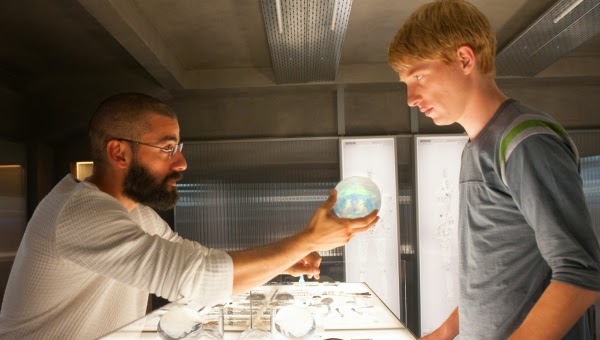
From prolific screenwriter Alex Garland (The Beach, Sunshine and Dredd to name but a few) comes sci-fi drama Ex Machina. A young programmer is selected to participate in an experiment run by his boss (Domhnall Gleeson and Oscar Isaac respectively) to test a revolutionary new robot (Alicia Vikander), aiming to determine whether she possesses self-awareness (picture a feature-length version of the Voight-Kampff test from Blade Runner). 

Away from the guiding hand of long-time collaborator and master film-maker Danny Boyle, Garland has, if anything, shrugged off the limitations of a mere writer and taken complete control of the project: the film has a stripped-down, almost B-movie sensibility where any superfluous frills have been trimmed and the occasional extravagance of Boyle’s action set pieces are gone. Make no mistake; this is not an action movie. It is a science-fiction drama packed with so many ideas that – had a less-competent writer taken it on – could very easily collapse under its own weight.


But the reason the film emerges not only unmarked but victorious is how it channels the philosophical discussion; through the three central performances. Domhnall Gleeson as shy coder Caleb channels the inner questions of the audience, reflecting our uncertainty and (understandable) fears about both the experiment and Oscar Isaac’s bearded boffin Nathan, a steely-eyed control freak convinced that he is Oppenheimer reincarnated, willingly creating something that could ultimately send his entire species back to the Stone Age.

Alicia Vikander is perfect as exquisite A.I. Ava, bringing to bear a nuanced performance that captures the slight uncanny valley effect of a robot imitating human life. Enhanced by seamless special effects, she gives every impression of a real person restrained by the limitations of what is essentially a computer programme: her eyes rove a little too precisely and her limbs go from swift motion to stock-still in a microsecond, all the while her inquisitive nature and sleek body involving us in issues of individuality, sexuality, and even the question many films have tried and failed to ask intelligently: what does it mean to be human?

The film is drenched in a cold and clinical colour palette whilst the music – a concoction of machine-tooled chimes and rasping electronic reverb – attempts to provoke a physical response. All this and more builds to a startling climax as the development of the plot throws our loyalties hither and thither, leading to the realisation that we are the ones being tested, not Ava: will you pass…or fail?

★★★★★

Tuesday, 20 May 2014

'The Two Faces of January' - Review

5/20/2014 10:10:00 am
'The Two Faces of January' - Review


Based on the novel by Patricia Highsmith, The Two Faces of January is a thriller centred on rich con artist Chester MacFarland (Viggo Mortensen), his alluring younger wife Colette (Kirsten Dunst) and a young stranger named Rydal (Oscar Isaac) as they are caught up in the murder of a private investigator and their attempts to escape justice set against the backdrop of the 19060’s Mediterranean. 

The film’s biggest strength is undoubtedly its three leads: they are constantly kept front and centre stage, with little to no side characters ever having to become drawn in unless absolutely necessary, which leads to a much higher level of engagement and keeps the focus tight. Viggo Mortensen is – as always – a magnetic screen presence, creating a perfect mix of a man of great extravagance and charity but always with the mind-set of ‘what can I get out of this?’ Oscar Isaac is also great, his deliberately wavering accent leading you to believe that Rydal may not be entirely truthful when discussing his origins, lending the character a great sense of mystery. 


Kirsten Dunst performs admirably, but is sadly underused and often cast aside, though this may be a problem inherent in the source material and not the fault of the film. In fact, the sensibility of the book seems to have given the film both a great strength and a quite noticeable flaw. Whilst it carries with it a great film noir sensibility – only it trades the claustrophobia of a city for the exposed landscapes of Greece and Crete – this also means that, in the end, it’s quite forgettable in a throwaway, pulpy sort of way, and within a few days you probably won’t remember what exactly the plot was.

Going back to the positive side, the film looks terrific. Production designer Michael Carlin’s attention to period detail is most impressive, meaning that not once did I spot someone in the background using a mobile phone or using a car that hadn’t been designed yet, as is sometimes the case with a film set firmly in the past. The whole production is bathed in a very over-exposed, golden-orange light which gives a great sense of overbearing heat and exposed paranoia, and means that when the scenes that are set at night show up that you do actually feel cooler and safer.

There are just one or two other problems I have with the film, the first being that it is too short. 96 minutes might sound ideal for a throwaway pulp story, but I rather hoped the film might expand on the book, do its own thing and give us just that little bit more. The brief running time means that the final scenes feel awfully rushed and a little unresolved, and initiates my second problem: the film begins with Chester and Dunst in Greece, enjoying themselves, and within 15 minutes the incident involving the private detective has happened yet we’ve had no real insight into their characters. Sure they sit and chat – and smoke enormous amounts of cigarettes – over a meal with Rydal but I didn’t really feel I knew them well enough to become invested in their problems that quickly.

Whilst constrained by its pulp origins and cut short of aspiring to anything greater, The Two Faces of January is still an entertaining drama that takes it strength from remarkable central performances, a minute eye for period detail, and a real visual flair. It isn’t likely to make a lasting impression, but as a piece of entertainment it’s perfectly fine.

3 stars