Chris At The Pictures: alex garland
Showing posts with label alex garland. Show all posts

Friday, 16 March 2018

'Annihilation' - Review

3/16/2018 09:04:00 pm 1
'Annihilation' - Review

★ ★ ★ ½ ☆


Alex Garland’s sophomore film as writer-director, based on the book by Jeff VanderMeer, is a sci-fi oddity packed with questions and imagery which overwhelm and outshine its strong cast. Natalie Portman is Lena, a biologist sent to investigate a strange occurrence known as the Shimmer when her husband Kane (Oscar Isaac) returns after going missing on his own expedition, wracked with strange symptoms. Lena is joined by four other scientists (Jennifer Jason Leigh, Tessa Thompson, Gina Rodriguez and Tuva Novotny) to venture past the Shimmer’s dripping rainbow barrier and into the unknown.

To have a major science fiction film headed up by five women is a wonderful prospect, but in the end their characters are secondary to the visuals and ideas. Portman, Thompson, Isaac and Jason Leigh have the most fleshed-out roles of the bunch, but the nature of their occupations and the unravelling plot means they have little room to display more than quiet disconnect and pure fear. Anyone who’s accused Christopher Nolan of being clinical will soon be admiring his more sentimental qualities after spending two hours in the company of biologists, psychologists and hazmat-suited observers armed with clipboards.

Now for the sadly unavoidable digression, given that yours truly is reviewing this film from the UK: Annihilation doesn’t belong on the straight-to-streaming pile. Its grandiose imagery and even larger ideas belong in a cinema, where an audience is paying directly (thereby showing more tangible support for cerebral sci-fi than a lone viewing statistic), breathing in the visuals from a pristine projection source and, most importantly, not tabbing out every five minutes to check Facebook. Whatever the objective flaws and merits of Netflix’ current sci-fi releases like AnnihilationThe Cloverfield Paradox and Mute (the less said about Bright, the better), they’re shot with the big screen in mind. I can’t for one minute imagine Alex Garland or Duncan Jones conversing on-set with their director of photography about how best to shoot a sequence for optimal impact on a cropped desktop window. 
The best I could do to replicate a theatrical experience for Annihilation was a 23-inch monitor, turning all the lights off, putting on a decent pair of headphones with the volume up and praying my internet connection held long enough to retain maximum resolution. The latter proved the most unreliable element, meaning Rob Hardy’s eerie cinematography resembled something closer to Annihilation: The ZX Spectrum Experience. Drops in bitrate still failed to break the spell of a frightening, spine-chilling score from genius composers Geoff Barrow and Ben Salisbury, returning from Ex Machina.

A few other elements from Garland’s previous directorial outing cling to the surface of Annihilation as it leaps from straight science fiction to bizarre, exploratory philosophy: there’s a lot of photography through glass (cell windows, the warped reflections of a glass of water), large gaps of ambiguous silence between dialogue and a frugal use of CGI. What digital imagery there is flits from astonishing to awkward. Where the VFX budget has been spent really shows, and the more questionable effects weirdly make the film feel more suited to its home platform doom.

As with Ex Machina’s tests, this film is fragmented into stages, each infused with a recurring close-up of dividing cells, an image echoed in the scientists’ continuing discoveries. Much as one cell becomes another, brief physical evidence (plants that have formed themselves into the shape of human bodies, skeletons arranged in the sand) spawns more mental imagery that is harder to shake, itself upstaged by succeeding sequences that teeter on the edge between dream and nightmare. A vignette in an abandoned swimming pool refused to leave the inside of my eyelids for several days.

Garland keeps this adherence to ‘less is more’ to a fault. So much of the screenplay revels in withholding information from the audience, and it’s difficult to decipher whether he’s leaving these questions unanswered or merely open to interpretations. This means Annihilation could be read as any number of things: for yours truly, it’s a fable about leaving the unknown alone, but you can also see commentaries on gender, mankind’s destruction of the environment, and what it means to be human. It’s a film of big ideas, and that’s something no amount of relegation to small screens can diminish.
Friday, 23 January 2015

'Ex Machina' - Review

1/23/2015 10:21:00 am
'Ex Machina' - Review
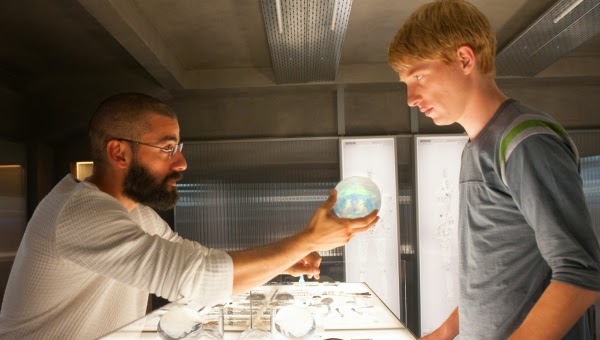
From prolific screenwriter Alex Garland (The Beach, Sunshine and Dredd to name but a few) comes sci-fi drama Ex Machina. A young programmer is selected to participate in an experiment run by his boss (Domhnall Gleeson and Oscar Isaac respectively) to test a revolutionary new robot (Alicia Vikander), aiming to determine whether she possesses self-awareness (picture a feature-length version of the Voight-Kampff test from Blade Runner)

Away from the guiding hand of long-time collaborator and master film-maker Danny Boyle, Garland has, if anything, shrugged off the limitations of a mere writer and taken complete control of the project: the film has a stripped-down, almost B-movie sensibility where any superfluous frills have been trimmed and the occasional extravagance of Boyle’s action set pieces are gone. Make no mistake; this is not an action movie. It is a science-fiction drama packed with so many ideas that – had a less-competent writer taken it on – could very easily collapse under its own weight.


But the reason the film emerges not only unmarked but victorious is how it channels the philosophical discussion; through the three central performances. Domhnall Gleeson as shy coder Caleb channels the inner questions of the audience, reflecting our uncertainty and (understandable) fears about both the experiment and Oscar Isaac’s bearded boffin Nathan, a steely-eyed control freak convinced that he is Oppenheimer reincarnated, willingly creating something that could ultimately send his entire species back to the Stone Age.

Alicia Vikander is perfect as exquisite A.I. Ava, bringing to bear a nuanced performance that captures the slight uncanny valley effect of a robot imitating human life. Enhanced by seamless special effects, she gives every impression of a real person restrained by the limitations of what is essentially a computer programme: her eyes rove a little too precisely and her limbs go from swift motion to stock-still in a microsecond, all the while her inquisitive nature and sleek body involving us in issues of individuality, sexuality, and even the question many films have tried and failed to ask intelligently: what does it mean to be human?

The film is drenched in a cold and clinical colour palette whilst the music – a concoction of machine-tooled chimes and rasping electronic reverb – attempts to provoke a physical response. All this and more builds to a startling climax as the development of the plot throws our loyalties hither and thither, leading to the realisation that we are the ones being tested, not Ava: will you pass…or fail?