Chris At The Pictures: domhnall gleeson
Showing posts with label domhnall gleeson. Show all posts

Tuesday, 19 September 2017

'mother!' - Review

9/19/2017 10:29:00 pm 0
'mother!' - Review

★ ½ ☆ ☆ ☆

After the big budget blowout of Noah, Darren Aronofsky returns to simpler times with this deliberately provocative tale of a man and woman (Javier Bardem and Jennifer Lawrence, whose characters remain unnamed) living peaceful, but soon-to-be interrupted lives. Basking in their Eden-like seclusion, Lawrence’s eponymous matriarch sets about restoring the house (with which she shares a mysterious, organic connection), while Bardem plays a troubled poet looking to write his masterwork. Just as inspiration appears to strike, an unknown couple (Ed Harris and Michelle Pfeiffer) stumble upon the pair, bringing with them the unspoken threat of upset and destruction.

For all it’s unclear narrative strokes and ambiguous dialogue, mother! is not a subtle film. The instant it’s central metaphor takes root, it's nigh-on impossible to focus on anything else. The intended discomfort and tension as Harris and Pfeiffer encroach upon the couple’s handiwork is totally undermined by an allegory so ham-fisted you could slice it up and serve it in sandwiches.

That a film so steeped in parable and analogy is playing in multiplexes should be something to celebrate, making Aranofsky’s failure to combine symbolism with a compelling story that much more infuriating. The overriding thesis of the film – at least, as it was apparent to me – is one I sympathise with, but I can’t see it winning over the average movie-goer. As evidenced by the movie’s plummeting CinemaScore across the pond, they’re likely to remain resolutely alienated by a mood piece comprised mostly of Jennifer Lawrence gasping and shrieking at the camera.

To see Lawrence return to comparatively ‘out there’ cinema after her string of mainstream roles is an exciting prospect, and sadly remains just that: something still to come. Her role here (to use the word ‘character’ seems generous considering her deployment as reflection or caricature) gives us nothing but fear and loathing, of which she gave ample demonstration across all four instalments of the Hunger Games series.

Pfieffer tries to save what she can (largely through a particularly delicate method of sipping lemonade), but it’s a hopeless effort. She – along with Harris and brief spells from Dohmnall Gleeson and Kristen Wiig – becomes just another face in the crown of walking, talking emblems that slowly but surely begin to overwhelm the isolated abode.

This increasingly fraught and claustrophobic home-invasion section of the film is where things truly go to pot. In terms of pure technical construction, there should be much to admire as time, space and bodies fast-forward, tighten and twist in a finale clearly designed to shock and awe. The established composition of mother! (a repetitive, clumsy and dull array of close-ups and over-the-shoulder shots) instead consigns us to crock and bore.

Tuesday, 12 September 2017

'American Made' - Review

9/12/2017 10:59:00 pm 0
'American Made' - Review

★ ★ ★ ☆ ☆

Sold almost entirely on Tom Cruise’s ability to deliver a cheeky grin, American Made tells the ridiculous true story of Barry Seal, a TWA pilot hired by the CIA to provide reconnaissance footage in the early eighties. His skills are soon noted by the Medellin Cartel, and thus begins an eight-year odyssey of drug smuggling, arms dealing and mountains of cash large enough to shame Scrooge McDuck.

Cruise is back working with director Doug Liman, who – after achieving the impossible by making Hollywood’s ever-youthful hero look genuinely rattled in Edge of Tomorrow – makes a sharp 180-degree turn from their previous team-up. His direction and Gary Spinelli’s script turn the charisma dial up to eleven, giving Cruise that “I’m gonna buzz the tower” smirk we all recognize, but framing it in a frenetic and eye-popping series of increasingly ludicrous capers.

The film is also colour-timed to vibrant excess, but nowhere is the joy and madness more perfectly captured than by a supporting role from Domhnall Gleeson as CIA liaison ‘Schafer’, which proves once and for all that he’s at his best when doing sly, slimy cackling. Caleb Landry Jones also makes a brief but amiably bitter appearance as Seal’s homewrecking brother-in-law.

Occasionally, it is wearing. The whole Wolf of Wall Street vibe is a tad trite (Barry’s growing ambivalence to the jaw-dropping loads of money filling up his house, his preference for reading a book about the rise of Al Capone instead of confronting his problems), and the montages of our lovable pilot enjoying his vast extravagance face the same faults as Scorsese’s epic: we never really feel any ill-effects.

Nowhere is this more apparent than in the treatment of Seal’s wife, Lucy (Sarah Wright). As is now seemingly par-for-the course with this sort of film, she’s almost a footnote. Brought out mainly for eyebrow-arching sequences of the couple having sex in the cockpit mid-flight, her disapproval and shock are played only for laughter. It’s an approach that reflects the films near-refusal to tread into anything remotely dark or upsetting: despite the danger constantly dogging Barry (guns, goons and maybe a little guilt), any danger to the audience’s expectations or sensibilities is severely lacking. It’s a frivolous flight of fancy that provides a great vehicle for Cruise’s shtick and Liman’s swift direction, but nothing more than that. It’s fast to please, but faster to fade.

Tuesday, 19 January 2016

'The Revenant' - Review

1/19/2016 06:33:00 pm
'The Revenant' - Review

★ ★ ★ ½ 

Our constant companion throughout The Revenant (Alejandro González Iñàrritu’s tale of a left-for-dead frontiersman) is the harsh, wounded breathing of Leonardo DiCaprio’s Hugh Glass. Mutilated in a savage bear attack and abandoned by rival and fellow pelt-hauler John Fitzgerald (Tom Hardy), Glass begins an odyssey across the frozen wastes of the West, seeking vengeance. 

The recurring motif of Glass rising after yet another rough night under the stars perfectly encapsulates the strengths and weaknesses of the film. Despite the baggage of gobsmacking on-set reports and Oscar fever, DiCaprio’s performance is startlingly captivating, often rendering one of Hollywood’s most famous faces unrecognisable behind a beard matted with blood, mud and snot. As reluctant as I am to cave to award voters’ fawning for transformative performances, there’s no denial that this portrayal is anything less than sublime. For what must constitute 80% of the run-time, Leo crawls, chokes and chews his way across stunning landscapes, at once distracting from and contributing to the savage backdrop. 

And what extraordinary savagery it is, too: not since Gareth Evan’s follow-up to The Raid has cinematic pain been so viscerally convincing. A heart-thumping battle sequence followed closely by the bear brawl set us off at a sprint before grinding to a gritty, grimy crawl. This is where the problem with our constant focus on Glass comes into play: a very grumpy man waking up in the woods can only be entertaining so many times, and the endless repetition of grumbling into scummy beard, crawling a few paces, sleeping in a horse carcass etc. drags the centre section of the film into a dangerous gutter. As with Iñàrritu’s Birdman, the twenty minutes that inspire much watch-checking and fidgeting is the clumsy ink smudge on an otherwise unsullied work.

Reference to the cinematic frame as a painting is also applicable to Emmanuel Lubezki’s cinematography. His usual penchant for long, winding takes is dotted about the piece, but far more impressive are the moments when the camera is allowed a moment of stillness, to take in exquisite vistas of looming mountain ranges and biting, jet-black rivers. Some compositions are so ingeniously striking that I’m certain no-one has ever imagined anything like them: take, for example, a shot that places us within wisps of cloud, reminded of our lofty position above and beyond Glass’s plight as he drifts between the rage of his waking hours or the calm lucidness of his recurring daydreams. 

I’m not entirely convinced that any of these surreal outcroppings actually have anything important to say about human nature and how far we are willing to go for the sake of survival, vengeance, or both, but as long as they’re so wondrously mounted, I’m quite happy to go the distance.

With DiCaprio’s much pined-for Oscar pretty much a dead cert at this point, recognition of other great turns in the film is massively lacking to the point of negligence. Hardy has sported roles like this before, and his overwrought southern accent distracts from the great supporting work being done by Domhnall Gleeson as Glass’s sympathetic superior officer. Will Poulter also does well in a role which finally allowed me to see more of his talent and less of his eyebrows. In the midst of a film so often obsessed with unwashed hair, soggy fur and torn fabrics, this is not something to be undervalued. For all the muscular violence, ice-cold tone and stark imagery, the character-driven elements of The Revenant are what push it above a mere endurance test and into the realm of warm-blooded, human storytelling.

Sunday, 8 November 2015

'Brooklyn' - Review

11/08/2015 11:35:00 am
'Brooklyn' - Review


★ ★ ★ ★ 


Imagine, for a moment, that one of those dreary Nicholas Sparks adaptations was actually interested in its female lead, as opposed to the abs of its leading man as he sands down the hull of a boat/lifts weights/plays with his dog etc. That’s what we get in Brooklyn, John Crowley’s adaptation of the Colm Tóibín novel following young Irish immigrant Eilis (Saoirse Ronan). Eilis lands in 1950s New York as an escape from her claustrophobic life, but soon finds her heart torn between a new land, the country she calls home and the futures offered by both.

The film has a number of wonderful things going for it, but the steadfast element is surely Saoirse Ronan. She’s been a quintessential film star for a number of years but here she is truly mercurial. I know of no other performer capable of communicating such palpable emotions with the minutiae of facial expressions, be it fierce loss or heart-stricken desire. Around her, everyone seems determined to up their game, notably the ever-marvellous Julie Walters as a God-fearing but mischievous house-mistress and Jim Broadbent as tender Father Flood.

While these characters would suggest religious overtones, Eilis is far from a messianic character: she is complex and flawed; an agent of choice, not fate or destiny. The choice in question is not simplified into a single cliché moment, but explored throughout the film by her growing affection for Italian-American Tony (Emory Cohen), devotion to her sister Rose (Fiona Glascott) and over-riding homesickness for her small Irish town. 

The latter is beautifully examined in a little scene in which Eilis serves Christmas dinner to the dispossessed Irish men of Brooklyn, who once came across the sea –as she did – in search of something hopeful, but perhaps unattainable. This feeling of displacement is a way of articulating that belonging and nationality are about more than pride or patriotism: Eilis’ and her fellow countrymen’s sense of identity is portrayed not with flag-waving, but the smallest of gestures. 

Asides from the plentiful emotional heft (for this is an old-fashioned weepie in the best sense), the viewer has a sumptuous visual treat in store, the period detail exquisitely captured by shining cinematography and backlit by a score which treads the knife-edge between sweet and sickly.

Brooklyn won’t leave any lasting impact once the tears are wiped away, nor inspire a great deal of intelligent discussion, but might signify a possibility that this kind of film can be done right, even brilliantly. But beyond all that, Crowley and co understand that sometimes all you want from cinema is something that looks great, sounds great and is full to the brim with personable charm.

Friday, 23 January 2015

'Ex Machina' - Review

1/23/2015 10:21:00 am
'Ex Machina' - Review
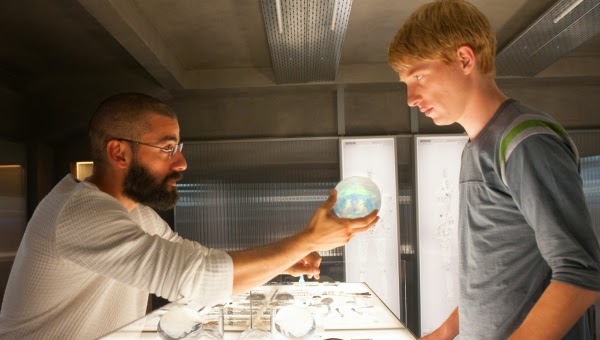
From prolific screenwriter Alex Garland (The Beach, Sunshine and Dredd to name but a few) comes sci-fi drama Ex Machina. A young programmer is selected to participate in an experiment run by his boss (Domhnall Gleeson and Oscar Isaac respectively) to test a revolutionary new robot (Alicia Vikander), aiming to determine whether she possesses self-awareness (picture a feature-length version of the Voight-Kampff test from Blade Runner)

Away from the guiding hand of long-time collaborator and master film-maker Danny Boyle, Garland has, if anything, shrugged off the limitations of a mere writer and taken complete control of the project: the film has a stripped-down, almost B-movie sensibility where any superfluous frills have been trimmed and the occasional extravagance of Boyle’s action set pieces are gone. Make no mistake; this is not an action movie. It is a science-fiction drama packed with so many ideas that – had a less-competent writer taken it on – could very easily collapse under its own weight.


But the reason the film emerges not only unmarked but victorious is how it channels the philosophical discussion; through the three central performances. Domhnall Gleeson as shy coder Caleb channels the inner questions of the audience, reflecting our uncertainty and (understandable) fears about both the experiment and Oscar Isaac’s bearded boffin Nathan, a steely-eyed control freak convinced that he is Oppenheimer reincarnated, willingly creating something that could ultimately send his entire species back to the Stone Age.

Alicia Vikander is perfect as exquisite A.I. Ava, bringing to bear a nuanced performance that captures the slight uncanny valley effect of a robot imitating human life. Enhanced by seamless special effects, she gives every impression of a real person restrained by the limitations of what is essentially a computer programme: her eyes rove a little too precisely and her limbs go from swift motion to stock-still in a microsecond, all the while her inquisitive nature and sleek body involving us in issues of individuality, sexuality, and even the question many films have tried and failed to ask intelligently: what does it mean to be human?

The film is drenched in a cold and clinical colour palette whilst the music – a concoction of machine-tooled chimes and rasping electronic reverb – attempts to provoke a physical response. All this and more builds to a startling climax as the development of the plot throws our loyalties hither and thither, leading to the realisation that we are the ones being tested, not Ava: will you pass…or fail?

Sunday, 11 May 2014

'Frank' - Review

5/11/2014 04:06:00 pm
'Frank' - Review


Frank is a comedy drama following the exploits of the fictional, unpronounceable indie band Soronprfbs and their new keyboard artist Jon (Domhnall Gleeson). The leader of the band, Frank (Michael Fassbender), lives every moment of his life wearing a giant papier-mâché head, a device loosely based on the 1980’s comedian Chris Sievey and his character Frank Sidebottom. Directed by Lenny Abrahamson (What Richard Did) and co-written by Sievey’s own bandmate Jon Ronson, upon whom Gleeson’s character is based.

It should be noted that I’m not fond of the ‘indie’ scene. I have no time for slow, drab ukulele music and the sort of navel-gazing, self-deprecating attitude and ‘quirky’ moniker that hangs like a black cloud over most of what is considered ‘indie’, the Zooey Deschanel character in 500 Days of Summer just about pushing my limits. As far as Frank is concerned, I was utterly charmed by it. The songs are not only unique and inspired, but they also help to create and work in tandem with the comedy elements with each of the band members given their own traits that prevent them from becoming bland and uninvolving side characters. They’re not just a lot of dreary soliloquizing but are intriguingly eccentric and boasting such an extraordinary range of instruments that it’s almost impossible to pick up on all of them in one viewing.


The most important thing about the film is that it is very, very funny. Ranging from physical comedy to vocal gags and entire set-pieces devoted to one joke, there’s much to enjoy here. Without wishing to spoil the fun for those yet to see it, a certain scene involving a Jacuzzi is tear-inducingly funny and just the Frank head by itself is so weird and placid that it’s comedy gold all by itself, not to mention the songs created out of the smallest little things, a standout of which would have to be Frank’s ode to a singular tuft of carpet.

Where performances are concerned, it’s interesting (but not surprising) that the Frank character has taken centre stage in the advertising for the film when really the true star is Domhnall Gleeson, who provides possibly the sanest voice in a film populated by over-blown characters and seems to be echoing a young Hugh Grant in his dumbfounded and stuttering moments, minus the upper-class smarm. That being said, Michael Fassbender – despite being shrouded contanstly in the enormous head – still manages to deliver a memorable performance as a man who seems to revel in the oxymoron of being forever hidden yet ecstatic at the prospect of fame. Maggie Gyllenhaal lends an enjoyable degree of depravity as control-freak Clara and Scoot McNairy (who is certainly going up in the world) provides a lot of laughs as the bands manager.

Though you feel that towards the end, a little of the magic starts to fade and the film wavers uncertainly, it manages to pull everything back for a low-key yet charming finale. Frank is not your average laugh-out-loud comedy, and though some may be put off by its off-beat, quirky attitude, it’s saving grace lies in the characters, their music, and the unashamedly wonderful eccentricity with which it carries itself. 

4.5 Stars