Chris At The Pictures: historical
Showing posts with label historical. Show all posts

Wednesday, 17 October 2018

First Man - Review

10/17/2018 03:09:00 pm 0
First Man - Review
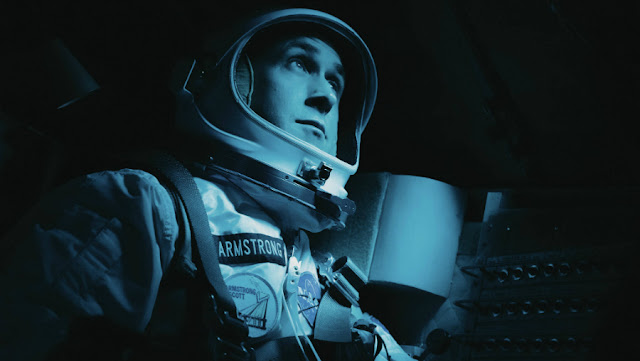
Ryan Gosling in FIRST MAN (Universal (c), still photo by Daniel McFadden)
★ ★ ★ ★ ★

Damien Chazelle makes the hat-trick with this extraordinary film that, appropriately, puts the man first. Ostensibly depicting the trials and tribulations of NASA’s Gemini and Apollo programs, First Man reveals itself to actually be about those of Neil Armstrong, in a refreshing break from space films that are less concerned - thematically, at least - with the inner workings of their central characters (Gravity is about survival, Interstellar is about time, The Martian is about collaboration, and so on).

Armstrong (Ryan Gosling) and his hopes, fears, treasures and turmoil are laid bare years before the dawn breaks on July 16th, 1969. Most are unspoken, all are devastating. The film begins with the death of his young daughter, Karen, and from there explores the near-decade Armstrong and his wife, Janet (Claire Foy) spent in the wake of that tragedy. Neil is concurrently engaged in constant danger, training for the race to reach the moon.

Far from a demonstration as the La La Land director’s new muse, First Man is the ultimate utilisation of Gosling’s best qualities as a restrained performer. His Armstrong speaks softly, withdraws from crowds, and has a crucial lack - if not active avoidance - of patriotic charisma (that cocksure role is taken up by Corey Stoll as Buzz Aldrin). Gosling says everything with a bowed head, an unfocused gaze, two fingers upon a pane of glass.

Though not explicitly stated by anyone on-screen (the 60s produced many revolutions, but open honesty about mental health wasn’t one of them), Neil’s depression is obvious to anyone who recognises that need to stay silent because admitting pain or anguish would make it real. Here’s a portrait of masculinity that flies in the face of everything one is taught from childhood of these supermen who trod amongst the stars.

Not that Armstrong is absolved entirely of blame for his continued distress. Claire Foy provides the crucial (and utterly indelible) voice of the audience as Janet, who desperately attempts to break down her husband’s emotional Faraday cage. In one of many moments of sheer heartbreak, she demands that Neil sit down and explain to their children that his small step may be a one-way trip. The boys reactions are muted, and they go off to bed almost as they would any other night, just as they returned to playing in the garden when an earlier test run briefly leaves their father spinning hopelessly above the Earth.

Because, for them, it’s impossible to truly comprehend what it means when your father tells you he might not come home. But Chazelle ensures we get the picture, with speaker-shattering launch sequences and dizzying Zero-G acrobatics that are second to none. Faces turn blue with unpreventable gasps and teeth are clenched together as though doing so will somehow hold the tenuous screws of the landing craft in place. Immaculate period detail hammers home the cramped, roughshod reality of early space travel like never before.

Production designer Nathan Crowley and special effects house Double Negative are not all that connects First Man to Interstellar (the inescapable benchmark with which all films of this kind must now compete). Justin Hurtwitz’s sonic accompaniment - by turns delicate and unnerving - follows Hans Zimmer’s lead and departs from a classical action score. The cue which heralds the climactic launch of Apollo 11 itself, however, would feel right at home amongst the late James Horner’s score for Apollo 13 (something about a soaring rocket seems to demand such a stirring piece).

Also present is the connection between a father and his unreachable daughter that forms the emotional core: one comes to realise very quickly that Armstrong’s devotion to his mission is so much more a personal quest than a political or occupational one. That this peace comes at the cost of lives, amity between nations and familial upheaval only adds to the burden of a man who just wants to escape the noise of the Earth as he does the din of a White House party.

Chazelle, Gosling and cinematographer Linus Sandgren reward him that, finally, on the largest canvas possible. Painfully intimate 16mm photography gives way to the liberating clarity of IMAX. Neil steps onto a globe all of his own. He - and the audience with him - breathes fully for the first time into a blissful silence. First Man may not end with a bang, but we certainly provide the whimper.

Tuesday, 23 May 2017

'King Arthur: Legend of the Sword' - Review

5/23/2017 12:00:00 pm
'King Arthur: Legend of the Sword' - Review

★ ★ ½ ☆ 

Chock full of smirk-inducing dialogue and many a fire-wielding enchanter, Guy Ritchie’s King Arthur: Legend of the Sword finds it very difficult to avoid the obvious Monty Python jokes. As the opening expository scroll faded, to be replaced by the location marker ‘Camelot’, all I wanted to do was lean across to my neighbour and whisper “It’s only a model!” Far from the usual social anxiety, my reason for resisting was that I had no-one to talk to: in solidarity with the film’s lacklustre US box office performance, the cinema was nearly empty.

Emptiness is a key problem on-screen, too. For all the fusing of Ritchie’s guns ‘n’ geezers formula with indestructible myths, there’s nothing but sparse and superficial thrills to be gained. With so much of our pop culture landscape defined by retellings of Arthurian legend, this return to the original tale feels oddly derivative. Narratively, it’s more akin to Star Wars than any fantasy yarn of old: the wizards have all but died out, and a young man must summon the courage to wield his father’s blue-glowing weapon and face a series of trials and visions before confronting a black-clad enemy who’s bound to him by blood.

Charlie Hunnam portrays an Arthur raised in a brothel on the streets of Londinium, who swans about with his motley crew of characters who owe more to EastEnders’ Queen Vic than Antoine Fuqua’s King Arthur. Their exaggerated accents are jarring, but at least they’re committed to the ‘Danny Dyer goes LARPing’ aesthetic. Our lead remains resolutely on-brand, emoting purely through shoulder-squaring and the odd grimace.

While Hunnam is humdrum, Jude Law is far from a bore. Embracing the role of Arthur’s evil uncle, Vortigern, and all the leathery bellowing that comes with it, he may not be the most sympathetic presence, but is easily most fun to be around. One scene sees him deliver a threat to one of Arthur’s chums, cutting off their ear when they refuse to comply. Law repeats his deadly promise into the severed ear in a way that should instil stunned fear, but instead caused yours truly to stifle a giggle. Another such joy occurs later when a topless, gimp-masked Vortigern dares Arthur to “Come and touch me”.

The most sympathetic role by far is Ritchie's own blink-and-you’ll-miss-it appearance as a shady dealer who takes one look at the assembled cockney crusaders and delivers the gestural equivalent of “Nah, y’alright, mate”. By this point in the film, we’ve all made a similar assessment. The occasional, unintentional chuckle and a bravura opening sequence (which offers more to fans of the Halo: ODST video game than anyone else) are poor reward for the total lack of self-awareness on display, best demonstrated by the female characters. Arthur’s unnamed mage accomplice (played with eye-popping gusto by Astrid Bergès-Frisbey) is only brought up when the plot demands her mystical abilities but is otherwise forgotten because learning to write women isn’t something Ritchie and his cowriters (Joby Harold and Lionel Wigram) have bothered with yet. Similarly wasted is Katie McGrath, who British viewers will recognise from her role as Morgana in the TV series Merlin, killed off before five minutes have passed.

Despite the furious pacing, snap-zoom camerawork and Daniel Pemberton's glorious romp of a score, there’s no urgency to any of it. The constant use of slow-mo and a colour palette that forgets to include anything but orange and grey drains what energy there is until a cameo from David Beckham fails to elicit even the most exasperated smirk. Legend of the Sword’s slim but laudable potential slowly gives way to a drab exercise in indulgence and buffoonery, its foul mouth betraying an empty head.

Friday, 24 February 2017

'Hidden Figures' - Review

2/24/2017 11:37:00 am
'Hidden Figures' - Review

★ ★ ★ ★ 

It’s the early 1960s, and the civil rights movement is taking flight. A march is taking place that will forever decide the future of the United States, a march where an oppressed minority will rise up and demand better. However, this isn’t Martin Luther King leading the long walk from Selma to Montgomery; this is Dorothy Vaughan (Octavia Spencer) leading her fellow mathematicians from their segregated ‘colored’ section of the Langley campus to the main building. It’s a shorter, swifter journey but every bit as important, and forms the defining posture Hidden Figures, which tells the previously obscured story of the black women (mathematicians, scientists, engineers) who were pivotal to the early victories of the US space programme.

Director Theodore Melfi adapts Margot Lee Shetterly’s book, focusing on three of these women: maths whizz Katherine Johnson (Taraji P. Henson), aspiring engineer Mary Jackson (Janelle Monáe) and the aforementioned Vaughan, denied supervisor role in her workplace by a white overseer (Kirsten Dunst). The film is sold as the struggle of ‘the women you don’t know behind the mission you do’, but as someone who wasn’t even that knowledgeable about the story hiding Johnson, Vaughan and Jackson from view, the impact was doubly felt. The separate strands of struggling minorities and an eyes-skyward approach to the future intertwine fantastically, with the latter never outshining the former.

I’m not about to go all poster-quote and say the performances are particularly nuanced or layered, because this is a film that realises that simplicity and sometimes predictability are necessary paths. However, they are completely believable, and utterly brilliant. Spencer’s years of experience provides the rightful guiding hand, Monaé gives us a constant reminder of the barriers placed upon African-American women at the time (as Mary battles for the right to study), and a new star in the skies of Hollywood. Henson takes centre stage as the first of the trio to break through into a higher field: Katherine is the only person of her colour in the highest offices of NASA, reporting directly to Kevin Costner as a fair but firm director. Despite her incredible achievements, she is still forced to make a forty minute to-and-from her segregated bathroom and given a separate coffee pot to her white male colleagues. Henson handles the central role with grace and ferocity, enough to keep Costner and a surprisingly strong Jim Parsons (The Big Bang Theory) on their toes.

It's difficult to imagine that Costner’s role was too much of a stretch for him, and it’s his character (a collection of several other people fused together for the sake of narrative ease) that feels the most like a concession to white audiences, to prevent accusations of bias (a bit rich, if you ask me). Mahershala Ali appears from time-to-time, too: if you accomplish nothing else in life, find someone who looks at you as adoringly as he looks at literally everyone in this film.

A scattering of critics have picked holes in what they see as a lack of technical prowess. Not only have they clearly missed the point, but they’re also just plain wrong; there’s some stellar work going on, formally. Hans Zimmer delivers his least intrusive score in years (allowing Pharrell to take most of the heavy-lifting), and Mandy Walker sneaks a handful of really great compositions into the cinematography. Characters stand behind glass panes or converse across mirrors, divided by window frames or other barriers that are every bit as thin and easily breakable as their fragile racial divides.

Also, perhaps it’s not showily constructed because (shock horror), the director is more interested in building characters and highlighting adversity than effects-heavy rocket porn? Melfi is doing what any good ally of people of colour should do: using their privileged access to these tools to tell a tale that wouldn’t otherwise be seen, but stepping back to allow that story and its message to speak clearly. “Civil rights ain’t always civil,” admits Jackson’s husband, but Hidden Figures is. Certainly, it never shies away from stark images of persecution and shocking ignorance, but it does so with its head held high, safe in the knowledge that any right-thinking person is on its side and smiling wryly in unison.


This is a story told affectionately; sentimental without being cheesy, inspirational without a roll of the eyes. Even if the wonderful cast, prescient message and triumphant spirit wasn’t enough to make it infectiously enjoyable, the fact we’re even getting an awards season movie starring three black women is a reason to smile. It’s a shockingly overdue smile, occasionally brought on by reliance on cliché, but, as Harrison says; “Progress is a double-edged sword”

Tuesday, 1 September 2015

'Straight Outta Compton' - Review

9/01/2015 12:40:00 pm
'Straight Outta Compton' - Review


★ ★ ★ ★ 

This is a superb piece of edutainment from director F. Gary Gray, taking its name from the debut album of NWA. It charts the rise of the group through the late 1980’s to early 90’s, following Ice Cube, Dr. Dre, Eazy-E and more from the mean streets of their hometown to world-conquering success. I should mention that watching this movie for me was like diving into the deep end: I knew nothing about the NWA, Compton, the Rodney King riots or even rap music as an art form. It is to the film’s very great credit that I found it as engaging, entertaining and tense as any mega-blockbuster action drama.

Straight Outta Compton really comes into its own in the performance department. The decision to cast O’Shea Jackson Jr. (the son of Ice Cube) as a younger version of his own father is an unexpected masterstroke: not only is the physical resemblance uncanny, but Jackson Jr. carries off the way Cube holds himself and even his facial tics to boot. Jason Mitchell also turns in a very fine performance as the young Eazy-E, drawing out the emotional core of the film while his counterparts (Corey Hawkins as Dr. Dre, Aldis Hodge as MC Ren, etc.) form a ring of confidence and energy around him. Paul Giamatti also appears to be having more than his fair share of fun as silly-wigged manager Jerry Heller, doing a lot of shouting and spitting in a quite diverting manner.

Whilst it’s true that a film like this is destined by default to re-tread the usual rock biopic beats, Compton differentiates itself by having the ‘behind-the-scenes’ moments (usually all too brief in its contemporaries) directed with as much – if not more – vigour, steadiness and attention to detail as the stage-shaking live shows and street-bound brawls: there’s sincerity behind the swagger.

Subtlety and delicacy aren’t always the guiding light, however. Wolf of Wall Street-level displays of excess run rampant throughout the second half, lending the length of the movie a somewhat bloated feeling. NWA’s success isn’t necessarily wearing to watch, rather the fact that I’m more interested to see the how and the why than the what. Problems also arise when the film avoids tackling the well-documented misogyny intertwined within NWA’s rise to power. A true-to-life story that’s prepared to address violence and political unrest shouldn’t be afraid to do the same with sexism.

Perhaps the film’s greatest feat (especially for those of us with little to no knowledge of the story, the debut album, or rap music itself) is reminding us that a genre of music stereotyped as merely provocative and thuggish is rooted in honesty and emotion. But for a few miniscule missteps, Straight Outta Compton’s depiction of NWA is as uncensored, urgent, and powerful as their music.

Wednesday, 7 January 2015

'The Theory of Everything' - Review

1/07/2015 08:50:00 pm
'The Theory of Everything' - Review
When you place a director of documentaries in charge of a full-blown cinematic biopic, worries over the episodic feel or the predictability of the true story are always there. However, James Marsh has – to a large extent – succeeded in putting those fears to rest in The Theory of Everything, the story of Stephen Hawking (Eddie Redmayne) and his relationship with his first wife Jane (Felicity Jones), as well as his early battles with motor-neurone disease.

The usual tropes of stopping every five minutes to explain the time setting or using Basil Exposition to keep the audience up to date are gone, replaced with a flowing, properly filmic narrative. We begin with Stephen at Trinity Hall in Cambridge, exploring his meeting with Jane and his early advances in physics which – while capably captured – are not the most interesting part of the film. Redmayne is given his real chance to shine when the effects of Hawking’s disease begin to worsen and he is confined forever to a wheelchair. It’s a truly transformative performance, a rare occasion when the following line (spoken in a stereotypical trailer narrator voice) is more than justified: Eddie Redmayne is Stephen Hawking. His portrayal of the great man is subtle, carefully considered, and painfully honest.


Felicity Jones simply glows as Jane, making the journey from endearingly precautious in the early years to steadfast and strained as challenge after challenge come knocking. The supporting cast is a hodgepodge of British talent, with Harry Lloyd growing into his role as the narrative progresses whilst David Thewlis pops up occasionally to be his usual charming self. Everyone involved gives it their all and their combined talent is what makes the balance of humour and darkness really work: you’ll find no mawkish sentimentality here.


The story itself does not emerge entirely unscathed: the cinematography is occasionally prone to TV-movie style sheen (an odd choice considering the increasingly painful subject matter) and Jóhann Jóhannsson’s musical score sounds like the very definition of Oscar-bait. But in the grand scale of the film, none of this leaves a sizeable blemish: whatever else may be wrong with it, The Theory of Everything is ultimately a celebration of two lives lived to the full no matter what. It is an honest piece that gives both parties their due without feeling the need to worship at the feet – or wheels – of either.

★★★★