Chris At The Pictures: jason clarke
Showing posts with label jason clarke. Show all posts

Wednesday, 17 October 2018

First Man - Review

10/17/2018 03:09:00 pm 0
First Man - Review
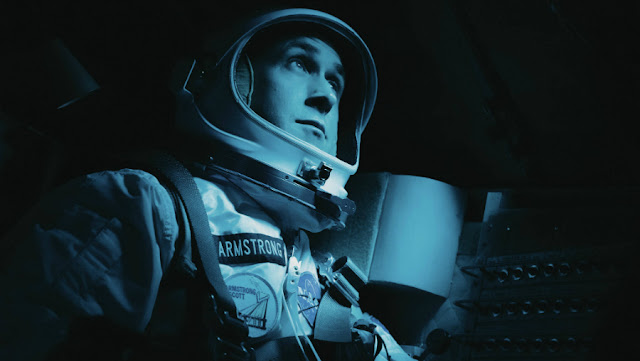
Ryan Gosling in FIRST MAN (Universal (c), still photo by Daniel McFadden)
★ ★ ★ ★ ★

Damien Chazelle makes the hat-trick with this extraordinary film that, appropriately, puts the man first. Ostensibly depicting the trials and tribulations of NASA’s Gemini and Apollo programs, First Man reveals itself to actually be about those of Neil Armstrong, in a refreshing break from space films that are less concerned - thematically, at least - with the inner workings of their central characters (Gravity is about survival, Interstellar is about time, The Martian is about collaboration, and so on).

Armstrong (Ryan Gosling) and his hopes, fears, treasures and turmoil are laid bare years before the dawn breaks on July 16th, 1969. Most are unspoken, all are devastating. The film begins with the death of his young daughter, Karen, and from there explores the near-decade Armstrong and his wife, Janet (Claire Foy) spent in the wake of that tragedy. Neil is concurrently engaged in constant danger, training for the race to reach the moon.

Far from a demonstration as the La La Land director’s new muse, First Man is the ultimate utilisation of Gosling’s best qualities as a restrained performer. His Armstrong speaks softly, withdraws from crowds, and has a crucial lack - if not active avoidance - of patriotic charisma (that cocksure role is taken up by Corey Stoll as Buzz Aldrin). Gosling says everything with a bowed head, an unfocused gaze, two fingers upon a pane of glass.

Though not explicitly stated by anyone on-screen (the 60s produced many revolutions, but open honesty about mental health wasn’t one of them), Neil’s depression is obvious to anyone who recognises that need to stay silent because admitting pain or anguish would make it real. Here’s a portrait of masculinity that flies in the face of everything one is taught from childhood of these supermen who trod amongst the stars.

Not that Armstrong is absolved entirely of blame for his continued distress. Claire Foy provides the crucial (and utterly indelible) voice of the audience as Janet, who desperately attempts to break down her husband’s emotional Faraday cage. In one of many moments of sheer heartbreak, she demands that Neil sit down and explain to their children that his small step may be a one-way trip. The boys reactions are muted, and they go off to bed almost as they would any other night, just as they returned to playing in the garden when an earlier test run briefly leaves their father spinning hopelessly above the Earth.

Because, for them, it’s impossible to truly comprehend what it means when your father tells you he might not come home. But Chazelle ensures we get the picture, with speaker-shattering launch sequences and dizzying Zero-G acrobatics that are second to none. Faces turn blue with unpreventable gasps and teeth are clenched together as though doing so will somehow hold the tenuous screws of the landing craft in place. Immaculate period detail hammers home the cramped, roughshod reality of early space travel like never before.

Production designer Nathan Crowley and special effects house Double Negative are not all that connects First Man to Interstellar (the inescapable benchmark with which all films of this kind must now compete). Justin Hurtwitz’s sonic accompaniment - by turns delicate and unnerving - follows Hans Zimmer’s lead and departs from a classical action score. The cue which heralds the climactic launch of Apollo 11 itself, however, would feel right at home amongst the late James Horner’s score for Apollo 13 (something about a soaring rocket seems to demand such a stirring piece).

Also present is the connection between a father and his unreachable daughter that forms the emotional core: one comes to realise very quickly that Armstrong’s devotion to his mission is so much more a personal quest than a political or occupational one. That this peace comes at the cost of lives, amity between nations and familial upheaval only adds to the burden of a man who just wants to escape the noise of the Earth as he does the din of a White House party.

Chazelle, Gosling and cinematographer Linus Sandgren reward him that, finally, on the largest canvas possible. Painfully intimate 16mm photography gives way to the liberating clarity of IMAX. Neil steps onto a globe all of his own. He - and the audience with him - breathes fully for the first time into a blissful silence. First Man may not end with a bang, but we certainly provide the whimper.

Thursday, 24 September 2015

'Everest' - Review

9/24/2015 04:15:00 pm
'Everest' - Review


 ★ ★  ☆

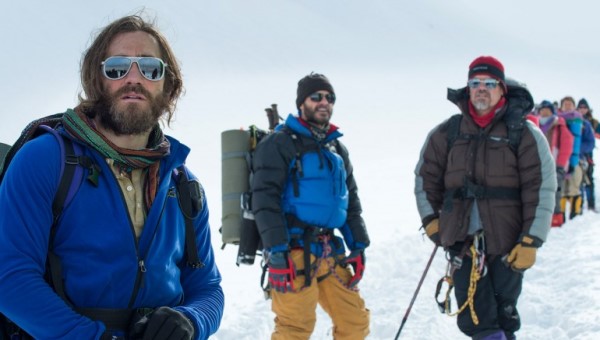
Here’s an intense but crowded disaster epic from director Baltasar Kormákur, detailing an ill-fated expedition to the peak of Mount Everest in 1996. Jason Clarke stars as Rob Hall, the head of a massive tourist pack heading up the slopes. Among his entourage is Josh Brolin as Texan adventurer Beck Weathers, Jake Gyllenhaal as mountaineer Scott Fisher and Emily Watson as base camp leader Helen Wilton. 

While it’s no surprise that Jason Clarke is excellent, the real stand-out performances come from Watson and Brolin, particularly incredible for the former considering she’s tied to a phone for a sizeable chunk of screen-time (as is Keria Knightley as Rob’s wife Jan). Brolin has never been much of a selling point for me, but here he’s a wonder to watch as Beck’s go-gettin’ attitude is slowly and cruelly worn away by the ascent.


As one might expect with a true-to-life story, a reverential tone is maintained throughout, particularly by Dario Marianelli’s unfurling score and a script that doesn’t waste time trying to glamourize the climbers as heroes or stigmatize anyone for what may or may not have gone wrong. The mountain itself is also given due respect: a recurring shot with the cast shunted to the side of the frame as Everest looms all around – just itching for them to put a foot wrong – illustrates the famous peak as a character in itself.


Blacing the many characters and respective tangents was always going to be difficult, and sadly Everest makes a bad job of it: Gyllenhaal’s Scott Fisher is sporadically returned to every once in a while almost as an afterthought, which feels ill-befitting not only of his talent as an actor, but also disrespectful of his real-life counterpart. Constantly switching perspectives adds a lot of un-necessary running time too, but at the same time other parts of the story feel underdeveloped. Elements of the real-life tale that are still under speculation to this day are handled mostly through hasty cutaways to other events or by having characters simply drop from the frame…sometimes literally!


The marketing attempts to sell this as a snowbound Gravity  (even the tagline ‘Never let go’ is but a word shy of the subtitle adorning posters for Cuarón’s space stunner), but the final effort often loses focus, despite being no less terrifying and beautiful in its own regard. I respect and admire Everest as a thrilling and thoughtful retelling of extraordinary events, but unlike its many characters, Kormákur falls short of the summit.
 

Saturday, 4 July 2015

'Terminator Genisys' - Review

7/04/2015 10:45:00 pm
'Terminator Genisys' - Review


"There is no fate but what we make"…and re-make…and endlessly re-boot. The paraphrased mantra of heroine Sarah Connor (Emilia Clarke) lies at the centre of Terminator Genisys, the fifth entry in the franchise. Far in the post-apocalyptic future, resistance leader John Connor (Jason Clarke) sends Kyle Reese (Jai Courtney) back in time to protect his mother Sarah from the machines dispatched to kill her before she can avert judgement day. However, when Reese arrives back in 1984, he finds that the timeline has been altered, and Sarah is already under the protection of The Guardian, another Schwarzenegger-faced machine turned hero.


When the first glimpse of the latest instalment in James Cameron’s time-travelling robot franchise hit the internet, those of us unfortunate enough to remember Terminator Salvation felt a glimmer of hope. With a plot involving re-written timelines and sporting a fresh-faced new cast, it brought to mind Bryan Singer’s Days of Future Past or J.J. Abrams’ Star Trek, films which single-handedly re-invigorated entire franchises and wiped the slate clean of sub-par sequels. So, does Genisys give us a hat-trick?
Not quite, but it’s only a near miss. Genisys takes a much closer route to franchise rebooting to that of Jurassic World: it relies heavily on nostalgia for the original and best-loved portions of the series whilst ignoring or dis-crediting lacklustre sequels. To this effect it forgets that Terminator 3 or Salvation ever existed (hallelujah!) and focuses on playing (or simply replaying) the top trumps of The Terminator and Judgement Day

One particular aspect played to the full is the role of Schwarzenegger, reprising his role as the robotic protector of the Connors, and occasionally merged with a recreation of his original 1984 appearance as the T-101 sent to kill Sarah. Connor’s attempts to integrate ‘Pops’ into human life provide a healthy dose of comedy, coming to a head in a final gag that might just rival the oft-imitated ‘talk to the hand’. Whatever else might be said of Schwarzenegger’s acting, he consistently delivers reliable (if not always intentional) laughs that help prevent the film from becoming too full of itself and straight-faced, a mistake that Salvation made…and paid dearly for it. 

Emilia Clarke is fresh enough from her starring role in Game of Thrones to bring enough cred and gravitas to the role, and has nailed the Linda Hamilton’s trademark pout. Jai Courtney is a charisma vacuum as usual, a consistent problem when he’s ultimately supposed to be the audience’s guide through the story. His centrality also means that his fellows have to keep stopping between firefights to explain the time travel gobbledegook, stretching the film’s length like one of the T-1000’s liquid limbs. 

The remainder of the cast is also a mixed bag: Jason Clarke takes a supporting role as the aged John Connor and has a chance to put his strange, carved-looking features to good use in a neat twist (spoiled by most of the film’s marketing), whilst Oscar-winner J.K. Simmons is inexplicably wasted in a role which ends up having little to no influence on the proceedings whatsoever.

So yes, the action sequences are nowhere near as memorable as the originals (bizarre, given that the climax combines most of their classic moments into one), the dazzling special effects allow them to be diverting when the story calls for it, and most of the loose ends are neatly (if not always believably) tied up. The formula of Terminator Genisys might be a familiar one, but as Schwarzenegger’s Guardian says, it’s “old, but not obsolete”.

Tuesday, 22 July 2014

'Dawn of the Planet of the Apes' - Review

7/22/2014 09:08:00 pm 0
'Dawn of the Planet of the Apes' - Review


From director Matt reeves (Cloverfield) comes the much-anticipated sequel to 2011’s Rise of the Planet of the Apes, a re-boot of the classic film saga depicting a world in which intelligent simians have become the dominant species of the planet. Set ten years after the events of Rise, Dawn of the Planet of the Apes sees a world in which human civilisation has been reduced to ruins by the breakout of simian flu, while the apes themselves have made their home amongst the forests with Caesar as their leader. When a group of humans searching for a power source inadvertently stumble upon the apes’ city, the struggle for control of the planet begins. 

Perhaps the greatest strength Dawn has to offer are its characters, and the film-makers have daringly decided to have the apes form the central roles, and have the humans as the sideshow. Whereas in Rise and films like Avatar where the creatures are the focus but always depicted through human eyes, this film takes the complete opposite route: all the key events are from the apes’ viewpoint; the emotional highlights take place within their struggle, and does the inevitable carnage. All the philosophical and moral questions normally discussed by humans are delivered by Caesar and his companions, more tears are shed by the simians, their pain and anguish demonstrated by sign language and developing speech.


The motion-capture work used to transform actors such as Andy Serkis and Toby Kebbell into Caesar and antagonist Koba respectively is a work of art by itself. Never for one moment do you doubt that the apes are anything but real, their interactions with the human characters not only visually tangible but visceral on an emotional level too. Not to be overshadowed by the effects, Serkis provides a terrific performance as the ape leader struggling to keep the peace he knows is doomed to fail, and Kebbell is a sight to behold as the scheming opposite, grinding the dialogue ferociously between his teeth.

In terms of human performances, Gary Oldman – though given little screen time – delivers the most emotionally powerful presence in the entire film as military commander Dreyfuss, moving seamlessly from unshakeably determined to broken and hopeless in a world spiralling out of his control. Jason Clarke is also reliable as Malcom, leader of the group sent to find a new power source, but Keri Russell as his wife Ellie gives a stronger yet subtle performance.

Whilst the philosophical and political nature of the past Apes films are still recurrent, the musical score also appears to have taken a step back into the 1960’s, a string of drum-based and choral pieces appearing alongside the more modern-sounding motifs. Composer Michael Giacchino has taken his experience in reviving the music of 60’s staples such as Star Trek and applied it expertly here, drawing on the originals and his contemporaries for inspiration. The film is shot magnificently, presented in a full-frame aspect ratio that causes the action to burst from the screen more than 3D ever could, displaying the inventive cinematography and stark colour palette beautifully.

Dawn of the Planet of the Apes is an intelligent, thought-provoking and incredibly powerful science-fiction film that lives up to the series’ legacy and has the audacity to allow non-human characters to take centre stage, treating the audience as intelligent and trusting them to invest in the apes as much as – if not more than – the humans. Featuring terrific performances, special effects that will take decades to age and an attitude that is cinematic in its purest form, it will stand the test of time as a remarkable achievement in blockbuster film-making.

5 stars