Chris At The Pictures: ryan gosling
Showing posts with label ryan gosling. Show all posts

Wednesday, 17 October 2018

First Man - Review

10/17/2018 03:09:00 pm 0
First Man - Review
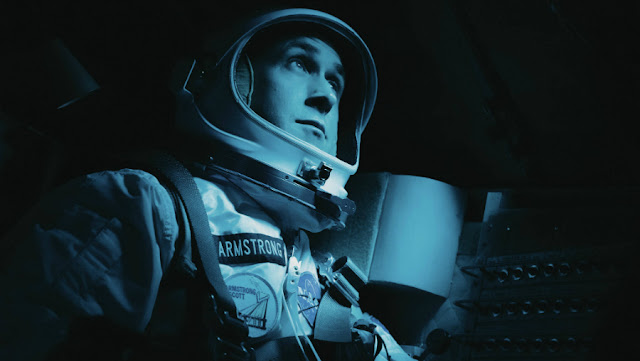
Ryan Gosling in FIRST MAN (Universal (c), still photo by Daniel McFadden)
★ ★ ★ ★ ★

Damien Chazelle makes the hat-trick with this extraordinary film that, appropriately, puts the man first. Ostensibly depicting the trials and tribulations of NASA’s Gemini and Apollo programs, First Man reveals itself to actually be about those of Neil Armstrong, in a refreshing break from space films that are less concerned - thematically, at least - with the inner workings of their central characters (Gravity is about survival, Interstellar is about time, The Martian is about collaboration, and so on).

Armstrong (Ryan Gosling) and his hopes, fears, treasures and turmoil are laid bare years before the dawn breaks on July 16th, 1969. Most are unspoken, all are devastating. The film begins with the death of his young daughter, Karen, and from there explores the near-decade Armstrong and his wife, Janet (Claire Foy) spent in the wake of that tragedy. Neil is concurrently engaged in constant danger, training for the race to reach the moon.

Far from a demonstration as the La La Land director’s new muse, First Man is the ultimate utilisation of Gosling’s best qualities as a restrained performer. His Armstrong speaks softly, withdraws from crowds, and has a crucial lack - if not active avoidance - of patriotic charisma (that cocksure role is taken up by Corey Stoll as Buzz Aldrin). Gosling says everything with a bowed head, an unfocused gaze, two fingers upon a pane of glass.

Though not explicitly stated by anyone on-screen (the 60s produced many revolutions, but open honesty about mental health wasn’t one of them), Neil’s depression is obvious to anyone who recognises that need to stay silent because admitting pain or anguish would make it real. Here’s a portrait of masculinity that flies in the face of everything one is taught from childhood of these supermen who trod amongst the stars.

Not that Armstrong is absolved entirely of blame for his continued distress. Claire Foy provides the crucial (and utterly indelible) voice of the audience as Janet, who desperately attempts to break down her husband’s emotional Faraday cage. In one of many moments of sheer heartbreak, she demands that Neil sit down and explain to their children that his small step may be a one-way trip. The boys reactions are muted, and they go off to bed almost as they would any other night, just as they returned to playing in the garden when an earlier test run briefly leaves their father spinning hopelessly above the Earth.

Because, for them, it’s impossible to truly comprehend what it means when your father tells you he might not come home. But Chazelle ensures we get the picture, with speaker-shattering launch sequences and dizzying Zero-G acrobatics that are second to none. Faces turn blue with unpreventable gasps and teeth are clenched together as though doing so will somehow hold the tenuous screws of the landing craft in place. Immaculate period detail hammers home the cramped, roughshod reality of early space travel like never before.

Production designer Nathan Crowley and special effects house Double Negative are not all that connects First Man to Interstellar (the inescapable benchmark with which all films of this kind must now compete). Justin Hurtwitz’s sonic accompaniment - by turns delicate and unnerving - follows Hans Zimmer’s lead and departs from a classical action score. The cue which heralds the climactic launch of Apollo 11 itself, however, would feel right at home amongst the late James Horner’s score for Apollo 13 (something about a soaring rocket seems to demand such a stirring piece).

Also present is the connection between a father and his unreachable daughter that forms the emotional core: one comes to realise very quickly that Armstrong’s devotion to his mission is so much more a personal quest than a political or occupational one. That this peace comes at the cost of lives, amity between nations and familial upheaval only adds to the burden of a man who just wants to escape the noise of the Earth as he does the din of a White House party.

Chazelle, Gosling and cinematographer Linus Sandgren reward him that, finally, on the largest canvas possible. Painfully intimate 16mm photography gives way to the liberating clarity of IMAX. Neil steps onto a globe all of his own. He - and the audience with him - breathes fully for the first time into a blissful silence. First Man may not end with a bang, but we certainly provide the whimper.

Thursday, 5 October 2017

'Blade Runner 2049' - Review

10/05/2017 07:31:00 pm 0
'Blade Runner 2049' - Review

★ ★ ★ ★ ★

It’s the dead of night. Unable to sleep, a man – dressed in his day clothes, a glass clutched in hand – stands watching the city below. Cars roll endlessly past, a thin film of rain trickles streetward and all around, the skyline is lit by the distant diodes of passing aircraft and countless illuminated windows. This is not Los Angeles, November 2019, but Norwich, October 2013. The man is not Rick Deckard, bounty hunter, but me. His reason for restlessness is not the spectre of five active replicants, but five consecutive viewings of Blade Runner, in its various cuts.

Getting so wrapped up in Ridley Scott’s vision, its implications, its warnings and its world was all well and good then for a pretentious film student devoid of a social life, but will serve no good to anyone approaching its newly-arrived sequel, Blade Runner 2049. Due to a combination of hectic working hours, late nights and sheer lack of luck, I had no time to revisit Scott’s troubled, moody masterpiece before diving into Denis Villeneuve’s follow-up. This failure meant that I entered the cinema neither freshly contemplative nor burdened with expectations heaped higher than a dystopian skyscraper.

For months I’ve been confused by Villeneuve’s statement that such a respected artefact of popular culture was impossible to follow, a horrific idea. Having seen it, now I understand why he still dared to take it on. For him (as demonstrated in all his works to date), it’s the storytelling that comes first. Finding a way to step out from under Scott’s near-inescapable shadow – something that took me the first hour of Blade Runner 2049 to accomplish – makes one free to understand the trials of Rick Deckard and his prey on their own terms. No matter the attachments to its predecessor (which are plentiful, necessary, and carry unprecedented catharsis), 2049 stands by itself in a way I could never have dreamed, deftly defying every possible expectation borne upon its back by legions who’ve already decided its redundancy, egged-on by clumsy marketing.

Picking up 30 years since Deckard and Rachel disappeared (during which a Y2K-style blackout all but wiped the records clean), we find ourselves in the shoes of LAPD Officer K (Gosling), deciphering a lead from a long-lost replicant outlaw. Caught between his police chief (Robin Wright) and the hitmen of resurgent replicant-manufacturer Niander Wallace (Jared Leto), K is set on a collision course with Deckard himself (Harrison Ford returns to complete his hat-trick of reprised roles).

It’s easy to crack jokes about Ford resurrecting performances from his eighties heyday, but less so when his latest tops them all by a country mile. Respecting Deckard’s character as originally written – by David Peoples and Hampton Fancher, the latter scribe resurfacing for this film – and Ford’s own doubts about his nature, the screenplay approaches the mystery in a way that not so much extinguishes as pours fresh fuel on the fires of ambiguity.

Gosling, Leto and Ana De Armas (leaps ahead from her turn in Eli Roth’s Knock Knock) were my main sources of contention going in but are cast perfectly by a director who understands how to utilise their strengths. Gosling’s frozen visage is played to unbelievable emotional effect, and Sylvia Hoeks proves herself a scene stealer from the word go as his predator, the ruthless replicant, Luv.

The talent behind the camera shines equally as bright. While many will bemoan the loss of Villeneuve’s long-time collaborator Jóhann Jóhannsson from the project, Hans Zimmer and fellow Dunkirk alumnus Benjamin Wallfisch more than step up to the plate with a soundtrack that dips sensibly into nostalgia without extravagant wallowing. And as for Roger Deakins, everyone else previously considered for upcoming best cinematography awards should stay home. His total mastery of composition allows us to finally glimpse what Roy Batty once told us we wouldn’t believe.

For those still put off Blade Runner from its perceived emotional iciness (something I’ve always struggled to understand, despite close friends emphatically claiming a lack of attachment to any of the characters), fear not. Though it begins in a similar lonely place, it grows into something that elicited an array of stricken and adoring responses from the shocked stillness of a murder scene to sobs as tremulous as the deepest earthquake.

In a mode of address more in line with the original, it still doesn’t see itself as an all-important delegate of decades still to come: Villeneuve, Scott and Fancher just want to tell a compelling story, to rediscover the key ideals of Philip K Dick’s source legend for a new generation. 2049 fills its (somehow breezy) 163-minute running time with questions about the aspirations of artificial beings and the nature of memory because such matters are demanded by the story, not out of some portentous desire to occupy the pages of philosophy textbooks for the next three decades. In an odd parallel to Scott’s own Prometheus, this takes the backdrop of a lonely, grimy sci-fi actioner to tell a story more concerned with belonging and promise. Forged in the crucible of an android’s dream, it looks tentatively, beautifully, to a future that may not discard its most helpless children after all.

Saturday, 14 January 2017

'La La Land' - Review

1/14/2017 06:51:00 pm
'La La Land' - Review

★ ★ ★ ★ 

Like many others, I’m sure; this review begins with a clarification. No, more a resigned confession: I’ve never been one for musicals. While everyone else of my generation grew up with the animated song-and-dance phenomenon of the Disney renaissance, the closest I got were cartoons with a few songs in them (predominantly Toy Story, the Phil Collins-heavy Tarzan and a crummy VHS copy of The Transformers: The Movie). There’ve been some exceptions every now and then, including but not limited to Jeff Wayne’s The War of the Worlds, parts of Les Miserables, and the time my housemate practically forced me to watch Chicago. Despite the varying quality of those examples, nothing has ever been able to shake my innate prejudice. I spent the opening logos of La La Land braced to cringe, waiting for the spasm in my gut and the embarrassed shiver to cross my cheeks…but neither came.

Instead, I spent two hours jigging my knee up and down in glee, weeping in wonder and beaming in total surrender, side-by-side with my mum (who, fittingly, took me to see Tarzan all those years ago). For those of you who’ve been living under a rock since the film’s dazzling first appearance at the Venice film festival, Damien Chazelle (Whiplash) directs Ryan Gosling and Emma Stone as Sebastian and Mia, two California dreamers who begin to fall in love after a chance encounter on a busy highway. Seb aspires to open his own Jazz club (in order to save what he sees as a dying genre), and Mia, a wannabe actor, is desperate to escape her life of serving coffee to the inhabitants of the Warner Bros. backlot (“That’s the street from Blade Runner!” – I whispered excitedly as the pair wandered among the vintage façades).

Yeah, I’ve never found myself attached to the grand heritage La La Land is so clearly besotted with, but throw in a location from one of my favourite movies, an original John Legend song and not one, but two sequences paying homage to Rebel Without a Cause, and you’ve got every inch of my being in an unrelenting embrace. Plus, giving Stone a lead role helps. Honestly, I could gush for hours about how her every eye roll, head spin and half-smile in this has extended my life expectancy by several decades, but we’d be here for twice that length.

Where Gosling is concerned, another of my long-held prejudices has been put to rest. While his woozy eyes have understandably wowed many, to me his expression has always appeared vacant, almost detached. In Shane Black’s The Nice Guys, this worked wonders (his character was a complete klutz), and here, too, his hazy gaze speaks to something authentic: the far-reaching mind of a dreamer. I finally get it, you guys.

Okay, now I’ve confessed and repented for my sins, can I gush about the routines, please? Cool, thanks: Justin Hurwitz’ songs are perfect, the dances move with the sweep and grace of sublime animation, and all are presented in a rainbow-soaked palette as flavoursome and primary as a packet of fruit pastilles. Standouts include a hilltop toe-tap (that moonlit beauty from the poster), a one-shot parkour through heavy traffic and a soaring waltz among the stars. Despite wanting to, I hesitate to blabber further: I’d hate to ruin any of what this film has in store.

In contrast to the stark colours, the morality of the story - of Seb and Mia’s victories and sacrifices - is far from black and white. I’m pressed to label it ‘earnest to a fault’…but, well; it hasn't got one! Chazelle knows we’re too cynical to buy a total lovesick ode to Tinseltown right now, so peppers the sweet with spice. Even I (a sometimes fantastically over-sentimental soul) could understand why the film makes certain moves towards the flip-side of fairy tales, undertaking manoeuvres I can’t illustrate any clearer for, again, fear of spoiling the surprise.

So: a glorious ear-worm of a soundtrack, astounding visuals, unfairly loveable stars and a surprisingly textured narrative…I think that just about covers it! Wait, there’s a ‘Take on Me’ cover, too? Complete with Gosling passive-aggressively plinking a keytar? Sod it, take your five stars and get out of here; you’re already too good for 2017 as it is.


P.S. Please don’t actually go, we need you. Badly.

Wednesday, 8 June 2016

'The Nice Guys' - Review

6/08/2016 07:43:00 pm 0
'The Nice Guys' - Review

 ★ ★  ☆


Shane Black is back with a decadently idiosyncratic 70s noir: Ryan Gosling stars as clueless P.I. Holland Marsh, drawn into the Los Angeles underground in 1977 when the death of a fading porn star sparks a dangerous investigation. Accompanied by one-time rival Jackson Healey (Russell Crowe), Marsh begins an odyssey of ineptitude in the search for runaway Amelia (Margaret Qualley).

Of the many things to enjoy about The Nice Guys, it’s the approach to a plausible 70s aesthetic that I appreciated the most. It’s not just that the period detail is perfect, but that the film-making itself adheres closely to conventions of the time: cinematography-wise, the opening shot carries a zoom straight out of Dirty Harry, whilst the night-time scenes are awash with deep, inky blacks that call to mind the late Vilmos Zsigmond. The music of the decade is not made a spectacle of, either: Escape (The Pina Colada Song) just happens to be playing quietly in the background of a bar, rather than providing the centrepiece to a zany gunfight or wacky escapade.

In fact, the comedy as a whole leans much more on slapstick than one might expect from the jaunty, wide-eyed expressions of its stars on the poster. Black is seemingly the first to make good use of the rather ‘dead behind the eyes’ look that always prevents me becoming invested in any character Gosling plays, making Marsh a hapless drunkard who appears constantly perplexed by everything from the infuriated outbursts of his daughter, Holly (Angourie Rice), to the workings of a toilet cubicle door. As for Crowe; who better than to play the washed-up has-been with a heart of gold? Healey’s love-hate bromance with Marsh is perfectly offset by Holly’s wry exasperation, Rice delivering a plucky performance way beyond her years. Matt Bomer also impresses as an ever-sneering hitman.

While the main players and their arena are certainly beguiling, it’s a shame that their general aura of aimless tipsiness lays thick over the structure and comedy stylings, too. Much like the characters they’re tied to, the various narrative threads meander around all over the place before eventually being roped back together by the end, whilst above-par laughs are rather sparse once things get moving. For every smirk at Marsh failing to cope with the sight of blood (mostly his own), there’s another drummed finger as we wait for the shooting to stop and the snark to start up again. There’s also a recurrent shying away from blood and vomit, an odd choice considering the film’s determination to clash the vulgarity of the period with the squeamishness of the leads.

But I challenge anyone to harbour ill-feeling when John Ottman and David Buckley’s score is easing you into a comfortably toe-tapping mood, the central duo glancing quizzically at one another, reflecting once again the audience’s confusion in their own haggard, cigarette-dangling-from-lower-lip way. Shane Black’s latest is a shambling drunk of a film, but one you’d miss if you didn’t run into it on a night out, and one you’d love to party with again.