Chris At The Pictures: felicity jones
Showing posts with label felicity jones. Show all posts

Saturday, 14 January 2017

'A Monster Calls' - Review

1/14/2017 12:57:00 am
'A Monster Calls' - Review

★ ★ ★ ★ ½ 

If you’ve ever been a fan of Doctor Who, you may vaguely remember a David Tennant episode called ‘Fear Her’. It revolved around a young girl struggling with loneliness and familial disruption, channelled through drawings which came to life via an alien host. From the barest glance, A Monster Calls resembles an extrapolated parallel to this story: Lewis MacDougall plays Conor O’Malley, a shy and bullied preteen whose mother (Felicity Jones) is suffering from terminal cancer, whose father (Toby Kebbell) is distanced by continent and circumstance, and whose grandmother (Sigourney Weaver) is uptight and uncaring. Conor is met not by an alien, but a fantastical tree monster (voiced by Liam Neeson), who springs from the boy’s drawings. The Monster promises to visit Conor three times, each encounter packed with a myth or legend. Upon the fourth visit, it will demand a story from the boy, a tale that will prove to be his ‘truth’.

For those who require more persuasion than references to a mediocre episode of British television, allow me another analogy: picture The Iron Giant filtered through the operatic spectacles of Guillermo Del Toro. Getting the picture yet? This is a boy and beast tale at its most thoroughly cinematic, where the power comes from a seamless combination of beautiful performances and truly fantastical film-making. Whilst MacDougall carries himself with the tenacity of the young Harry Potter leads from all those years ago, eagerly pulling at our heartstrings, Oscar Faura’s cinematography soars wondrously. As Felicity Jones brings me to tears for the second time this month simply by hugging someone, Fernando Velázquez’ score delivers the second blow. And, as the Monster brings rooftops tumbling down upon the landscape, so to do Liam Neeson’s words send tears cascading down our faces.

Yeah, it’s a tough one, this: if you’ve glanced at reviews, poster quotes or reactionary tweets, you may pick up your tickets confidently, sure you won't cry. Speaking from extremely personal experience, you’re very much mistaken. I detected a similar outpouring from my fellow cinema-goers; we’re talking everything from squelchy sniffing to full-on flannel face. This isn’t emotional manipulation on the film’s part, God no: it’s an impossibly well-crafted piece of catharsis, earned through the simplest admission. Endless empty thrillers still can’t mar the gravelly power of Neeson’s delivery, not least during the sublimely-crafted animated sequences, where fairy tales are restored to their cinematic glory and their interpretations left entirely to the imagination. Such a statement seems rather obvious, but after the trite and misjudged retellings of latter-day Disney, it’s a relief not to have ‘the other side’ of these recitals spelled out so blindingly.

If there are any weak links to be found in this glowing chain of interlocking visceral-technical achievements, they’re to be found on the side-lines: the boys that bully Conor deliver some very stilted and swappable dialogue (like many others, the film remains blind to the true complexities of playground trauma), while Sigourney Weaver – surely blessed with one of the most recognisable voices in film – has her weapon of choice scuttled by a flimsy accent. Perversely, it’s a scene in which she barely utters a single sound that redeems inflectional faults with immeasurable, lacerating power.


When moments of near-silence hammer our hearts as brutally as MacDougall's loudest cry of anguish, the film’s greatest success is revealed. At its heart, this is an uncomplicated, uncontaminated fable that insists on the emotion of escapism over any pseudo-psychological explanations, reducing the hideous messiness of pain into a pure and profound search for truth. The Monster’s emphasis on hearing Conor’s story is not a demand, but an act of empowerment; the permission given to every scared, lonely child to scream and rage and sob, to admit their quietest truth at thunderous volume.

Thursday, 15 December 2016

'Rogue One: A Star Wars Story' - Review

12/15/2016 04:37:00 am
'Rogue One: A Star Wars Story' - Review

★ ★ ★ ★ 


Back in October, a viral ad campaign for the latest Call of Duty game stated everyone's distaste for 2016 loud and clear, with the tagline "Screw this, let's go to space." Given all that's taken place since, Rogue One: A Star Wars Story – with its cast of multinational talent, themes of hope and resistance, and an incompetent villain with bad hair who sneers at the one woman who dares to defy him – couldn’t be more relevant if it tried. It’s less of a fingers-in-ears escape from reality and more a hyper-realised reflection.

Much like the political horizon, Rogue One takes us into uncharted territory, as the first of Disney-Lucasfilm’s planned array of standalone Star Wars stories taking place around the main saga. This first entry details the events leading up to A New Hope, in which a desperate Rebel Alliance attempts to steal the plans for the Empire’s ultimate weapon, the Death Star. Felicity Jones stars as Jyn Erso, a galactic delinquent with a familial tie to the Empire and a habit for disregarding orders. As the film progresses, she reluctantly amasses a band of heroes including disillusioned Imperial pilot Bodhi Rook (Riz Ahmed), Alliance Captain Cassian Andor (Diego Luna) and his sardonic droid partner, K-2SO (Alan Tudyk), plus monk/warrior duo Chirrut and Baze (Donnie Yen and Jiang Wen, respectively). Ben Mendelsohn plays the increasingly infuriated Director Krennic, whose connection to the Erso family provides the starting point for the story. Forest Whitaker also appears as frazzled extremist Saw Gerrera, one of the films many ties to The Clone Wars animated series.

Though this new addition to the saga fills a hitherto unknown gap in the recently re-established Star Wars canon, there are nods aplenty to Expanded Universe material, the place where the mission to steal the Death Star plans was first uncovered (as seen in the Dark Forces video game). Jyn’s father, Galen (Mads Mikkelsen, who spends a lot of time getting rained on), bears the forename of the original creator of the Rebel Alliance, Galen Marek (better known as Starkiller) from The Force Unleashed series, K-2SO smacks more than a little of HK-47 from Knights of The Old Republic, and there's an X-Wing versus Imperial walker denouement plucked from the cover of a Michael A. Stackpole novel.

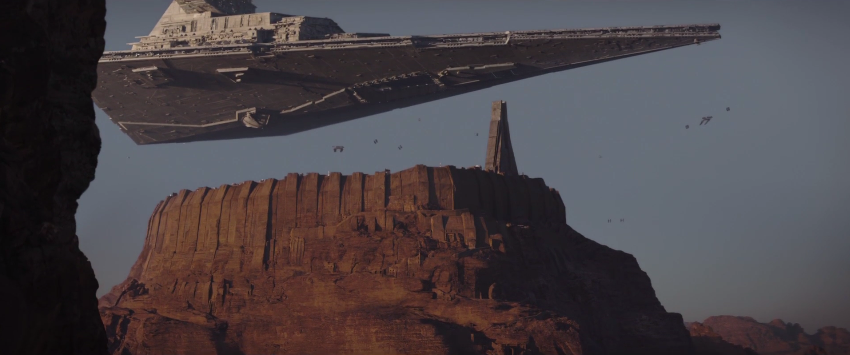
It's images like this swarm of buzzards taking on an armoured behemoth that helps Rogue One forge its own identity within the larger series and sell the apparent futility and hopelessness of an ailing resistance. The down-and-dirty camerawork itself feels spontaneous, even guerrilla, while establishing shots see the scale games director Gareth Edwards employed to brilliant effect in Godzilla magnified tenfold. Cinematographer Grieg Fraser turns this giant toy box into pure eye candy, with the Death Star as an irresistible jawbreaker at the centre.

Appropriately, while there is a chewy surface beneath, you might break your teeth attempting to get in: a somewhat higgledy-piggeldy first act means that initial character interplay is rushed, which makes seeing them as anything more than another set of archetypal action figures a little difficult. Of the bunch, Jones, Ahmed, Yen and Luna provide the most rounded personalities. If there is any justice in the world, Luna will soon be a gigantic star, and Yen will get further chances to demonstrate his comedic timing. Those with the least to prove (Ahmed and Jones, arguably) still give everything. Oh, and Mendelsohn is great fun as Krennic’s frustration mounts, because no-one does irritable scowling quite like him. A scene between his white-caped thug and a certain helmeted figure is a gift.

Now, for the Bantha in the room: those troublesome rumours of re-shoots intended to lighten the tone or bring the spirit of the film back in line with the other episodes. Fear not. Unless (like me) you’ve scrutinised the trailers more times than is healthy, any sign of later interference is inscrutable. The Force Awakens may be a more structurally coherent film, but this is a very different beast; a war movie more than a fantasy. The spectacle of Stormtroopers getting thrown about in huge explosions is followed by a grimace and a burst of dirt and shrapnel rather than a punchline. Humour is present of course, thanks mostly to Tudyk’s figurative (and completely literal) straight-faced delivery, but it’s less a continuing gag and more a reprieve. The grit and the grime is tangible, and all the (admittedly stellar) practical effects showboating of Abrams’ instalment seem piecemeal compared to what Edwards has achieved: the most ‘realistic’ Star Wars movie since 1980.

While we’re talking The Force Awakens, those who complained endlessly that it’s similarity to A New Hope signified Lucasfilm taking no risks with the franchise ought to be silenced, and possibly even more outraged now. Rogue One is most definitely a Star Wars prequel not only in the chronological sense, but also with regards to its risk-taking, its attempt to re-invent the series, and an insistence on blurring the line between physical and digital filmmaking like never before.  No, not every gamble pays off, but whether it leaves you aghast or amazed, the sheer audacity is gobsmacking.

The effectiveness of fan-service as an antidote should never be underestimated, however, and I doubt there’ll be a single dissenting voice rising against a note-perfect and utterly crowd-pleasing conclusion. These closing moments allow the movie to slide snugly into place with all the satisfaction of completing a high-scoring Tetris combo, with the blip-blop sound effects replaced by Michael Giacchino’s score. This, too, is where the film breaks from tradition. Giacchino’s music is not a symphony of motifs and themes, but a continuous soundscape that blends occasional call-backs with new material that, nevertheless, still retains that epic quality we’ve all come to expect.

As someone with a great deal of expectations, what I’m happiest about is how so much of this movie reminds me why I love this ridiculous franchise in the first place. The year between The Force Awakens and Rogue One has been a year of massive personal upheaval, and returning to a galaxy far, far away to find it still discovering ways to entertain and – most importantly – surprise me is one heck of a Christmas present.

Thursday, 27 October 2016

'Inferno' - Review

10/27/2016 11:50:00 am
'Inferno' - Review

★ ½ ☆ ☆ 

Tom Hanks returns as Professor Robert Langdon for another round of basilicas and balderdash in this hokey theological thriller adapted from Dan Brown’s novel. When Langdon awakens with a suspicious case of memory loss in Florence, Italy (around 5:42 AM, as the first in a series of pointless time checks informs us), doctor Sienna Brooks (Felicity Jones) whisks him away before a series of pursuers attempt to nab him for possible involvement in a deadly plague engineered by a TED Talking religious fanatic (Ben Foster). There’s an increasingly irritated Omar Sy as a W.H.O. operative, a lock-jawed assassin played by Ana Ularu, and Sidse Babett Knudsen doing her very best not to be dragged down by the cacophony of exposition and nonsense surrounding her.

“I need better from all of you!” she demands of her cohorts, although the same exasperated call could equally be levelled towards the cast and crew of this mess. One might argue attempting to transfigure a Brown novel into anything watchable is a terrible waste of time, but you’d think the combined efforts of director Ron Howard, lead actor Tom Hanks and composer Hans Zimmer might be able to salvage something. Alas, with The Da Vinci Code and Angels and Demons already testing that hypothesis to breaking point, Inferno secures the hat-trick.

After an unwatchable opening – in which Hanks burbles a lot about Langdon’s freaky visions and the camera shakes all over the place like the D.O.P. is on a Haribo-only diet – we’re back to the running and explaining that is the series’ predominant mode of address. There’s some pretention towards a complex web of conspiracy this time (complete with a plot twist that couldn’t be more obvious if an usher entered the cinema and announced it via megaphone), but David Koepp’s screenplay is more face-palming than head-scrambling. It’s not so much an intricately woven web of intrigue and deception as it is someone shouting excerpts from the Wikipedia entry on Dante while tumbling down a helter-skelter.

This half-completed join-the-dots puzzle is mirrored in the knotted frown lines consistently borne upon Hanks’ forehead and his total, bizarre lack of chemistry with Jones. Both more-or-less sleepwalk through their respective roles: he’s been here before, and Jones’ character is particularly undemanding. Omar Sy’s main job is to run around looking a bit miffed, whilst Irrfan Khan makes the most of any screen time to chew, savour, and swallow up the scenery.

However, the moment the film’s cast finally lost me (as I’m sure will be the case for a vast swathe of the UK audience) came when Paul Ritter – you know; the foul-mouthed dad, Martin, from Channel 4’s Friday Night Dinner – appeared as a shady agency overseer. As Langdon and Brooks make another escape, he pulls off his headset in frustration, and you half expect him to burst out with a hearty refrain of “Shit on it!”

If you thought some refuge from this execrable ensemble could be taken in the film’s technical achievements, you’d be wrong, because there really aren’t any. The framing and composition is all over the place, with everything ramped up to eleven to give the illusion of excitement. A lofty spinning shot – the sort that Michael Bay might use to frame a sunset-backed rocket launch or Ridley Scott to establish the surface of an alien world – is used here to encompass two people in an empty church reading something scrawled on a lump of plaster. Zimmer’s score is similarly disastrous, as if a classical orchestra and a Sega Genesis soundtrack were recorded in the same concert hall.

This is a bittersweet symphony for what could be the final cinematic outing for the Dan Brown/Ron Howard partnership, now they’ve finally (read: barely) conducted an entire trilogy. Any small sense of mystery or thrills has long since been neutered, and even the unintentional comedy wellspring has definitely dried up. The unspeakable box office takings may prove me wrong, but I think it’s time to give the bookshelves a good going over with a charity shop bag (or perhaps a flamethrower) to spare us further theological tosh.

Friday, 12 August 2016

'Rogue One: A Star Wars Story' - Trailer Breakdown

8/12/2016 08:02:00 am 2
'Rogue One: A Star Wars Story' - Trailer Breakdown


The latest glimpse at Gareth Edwards’ Rogue One (the first of Lucasfilm’s planned Star Wars spin-offs) hit the web in the early hours of this morning, bringing heaps of tantalising new footage as well as some recompense for fans unable to see an exclusive tease shown to a select audience at July’s Star Wars Celebration event in London.

For those still not in the know, Rogue One is set just prior to the events of the original Star Wars, and tells the story of a band of Rebels charged with stealing the plans for the Empire’s ultimate weapon; the Death Star. 

While we don’t get an awful lot of new plot details in this second, longer trailer, we do get a lot more insight into our central characters, something the previous teaser tended to bury beneath a flurry of classic Star Wars imagery. After an initial shot of a new planet, Jedha, we see Felicity Jones’s Jyn Erso visit Saw Gerrera (Forest Whitaker), a character previously seen in the Clone Wars animated show, now appearing as a battered, downtrodden resistance fighter with a deep-set grudge against the Empire.


“Imperial flags reign across the galaxy”, he says, as the payoff of the opening pan is revealed: an Imperial Star Destroyer hanging in the sky above the city, in homage to the opening of A New Hope.


After a brief re-tread of the plot setup from the first teaser, there’s a little more insight into the various character interplays. We get a hint of the camaradarie between Erso and Cassian Andor (an Alliance Captain played by Diego Luna), who hints that the team recruited to steal the Death Star plans have been sourced from a number of worlds. A craggy, rain-soaked planet glimpsed in short flashes could be the home of Baze Malbus (Wen Jiang) and companion Chirrut ÃŽmwe (Donnie Yen), whose Force-sensitivity is hinted at as he dispatches a squad of Stormtroopers.


The humour of Alan Tudyk’s motion –capture droid, K-2SO, briefly alluded to by the actor during the Rogue One panel at Celebration also gets a look-in. “The captain says you are a friend…I will not kill you”, he states dryly, bringing to mind the (sadly non-canon) musings of HK-47, a fan-favourite assassin droid from the RPG Knights of the Old Republic.


But before things can get too chummy, a doom-laden air descends as Jedha’s sun is eclipsed by the Death Star itself, and Ben Mendelsohn’s Director Krennic glowers planetward. An action-oriented rework of the Imperial march plays as the Rebels are shown in the heat of combat on tropical planet Scarif, outnumbered and outmatched by Imperial forces. “There is a 97.6 percent chance of failure”, K-2SO clarifies. 


The final seconds of the trailer delivers a flurry of hefty action, rife with spectacular imagery: X-Wings powering through stormy skies, the Rebel’s craft attempting to escape a cataclysmic debris field, and Jyn charging defiantly forward, even as a TIE Fighter hovers into view.


As the film’s logo appears, fans disappointed by the lack of Jimmy Smits’ returning Bail Organa or further footage of Krennic’s fearsome Death Troopers are soon rewarded with a single shot of Darth Vader, who gives us a solitary mechanical exhale before the trailer ends. Edwards promises that, used sparingly, Vader’s presence will loom large over the finished film, and this latest tease is a perfect demonstration. For all the exciting new worlds, further character establishment and more of Greg Fraser’s extraordinary cinematography (continuing his director’s penchant for making already terrifying objects seem more monstrous), it’s this momentary appearance from cinema’s most famous villain that will spark the fires of excitement and speculation all over again. 


'Rogue One: A Star Wars Story' hits UK cinemas on Friday, December 16th 2016

The new trailer can be watched here

A behind-the-scenes reel from Star Wars Celebration Europe 2016 can be seen right here

April's first teaser is still available here

Wednesday, 7 January 2015

'The Theory of Everything' - Review

1/07/2015 08:50:00 pm
'The Theory of Everything' - Review
When you place a director of documentaries in charge of a full-blown cinematic biopic, worries over the episodic feel or the predictability of the true story are always there. However, James Marsh has – to a large extent – succeeded in putting those fears to rest in The Theory of Everything, the story of Stephen Hawking (Eddie Redmayne) and his relationship with his first wife Jane (Felicity Jones), as well as his early battles with motor-neurone disease.

The usual tropes of stopping every five minutes to explain the time setting or using Basil Exposition to keep the audience up to date are gone, replaced with a flowing, properly filmic narrative. We begin with Stephen at Trinity Hall in Cambridge, exploring his meeting with Jane and his early advances in physics which – while capably captured – are not the most interesting part of the film. Redmayne is given his real chance to shine when the effects of Hawking’s disease begin to worsen and he is confined forever to a wheelchair. It’s a truly transformative performance, a rare occasion when the following line (spoken in a stereotypical trailer narrator voice) is more than justified: Eddie Redmayne is Stephen Hawking. His portrayal of the great man is subtle, carefully considered, and painfully honest.


Felicity Jones simply glows as Jane, making the journey from endearingly precautious in the early years to steadfast and strained as challenge after challenge come knocking. The supporting cast is a hodgepodge of British talent, with Harry Lloyd growing into his role as the narrative progresses whilst David Thewlis pops up occasionally to be his usual charming self. Everyone involved gives it their all and their combined talent is what makes the balance of humour and darkness really work: you’ll find no mawkish sentimentality here.


The story itself does not emerge entirely unscathed: the cinematography is occasionally prone to TV-movie style sheen (an odd choice considering the increasingly painful subject matter) and Jóhann Jóhannsson’s musical score sounds like the very definition of Oscar-bait. But in the grand scale of the film, none of this leaves a sizeable blemish: whatever else may be wrong with it, The Theory of Everything is ultimately a celebration of two lives lived to the full no matter what. It is an honest piece that gives both parties their due without feeling the need to worship at the feet – or wheels – of either.

★★★★