Chris At The Pictures: jake gyllenhaal
Showing posts with label jake gyllenhaal. Show all posts

Friday, 14 April 2017

'Life' - Review

4/14/2017 04:08:00 pm
'Life' - Review

★ ★ ★  

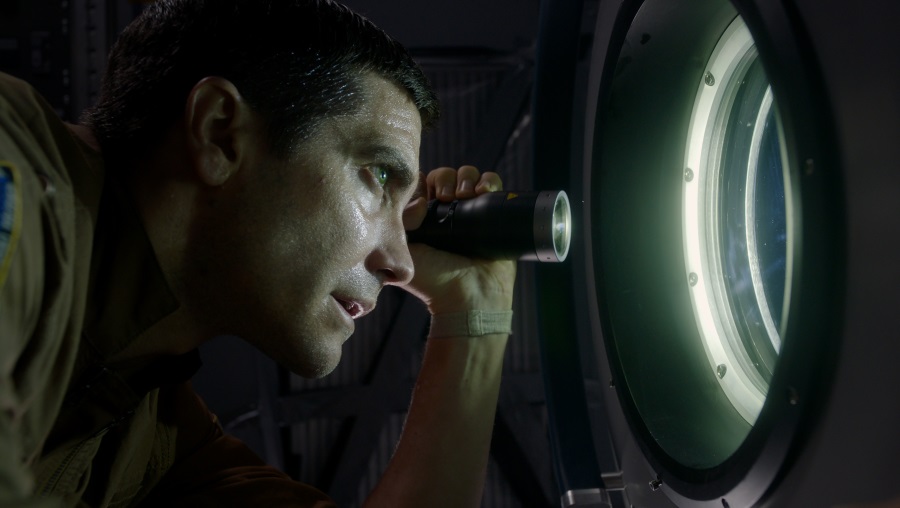
Jake Gyllenhaal returns to B-movie cinema in this weightless but efficiently gruesome space creepie. A team of astronauts and scientists on the International Space Station are thrilled when a probe dispatched to Mars returns laden with samples, one of which could demonstrate proof of life on the red planet. One such sample contains a miniscule but motionless organism. Being characters in a creature feature, they inevitably decide to inject it with nutrients, poke it with an electrical prod, and generally fiddle about in a way that can only lead to much yelling and crunching.

With the creature loose on the station, the film becomes an episodic series of chase sequences intercut with light musings on the nature of life, as the various inhabitants of the ISS (Gyllenhaal, Ryan Reynolds, Rebecca Ferguson et al) attempt to prevent ‘Calvin’ from reaching Earth.

With the basic premise and top-of-the-line visual effects taken into consideration, yes, it’s little more than Alien and Gravity blended together…but the resulting milkshake goes down well with a large popcorn. Gyllenhaal brings his A-game, even to what may seem a step down from his recent string of varied, comparatively arthouse roles, and Ferguson continues to build on a promise of stardom. Reynolds is rather less impressive, but for plot reasons as opposed to lack of ability. Hiroyuki Sanada (as in Sunshine, playing an awestruck astronaut who can’t catch a break) never gives a bad performance, and is suitably intense.

In short, they’re all good company when Calvin gets bored of them all moping about the Challenger disaster (a huge misstep in an otherwise amiable script) and decides to start separating various limbs and vital organs from their bodies. The creature is an effectively creepy amalgamation of several we’ve seen before and the gore is visceral and plentiful: picture the grisliest bits of Prometheus and you’re in the right ball park.


I really want to talk about the ending – because it’s the one part of the film that draws out anything more than a plaintive “Yeugh!” or shrill gasp – but all I can say without dropping spoilers is that you’ll never find a more jarring use of Norman Greenbaum’s Spirit in the Sky. It’s like tacking Peter Genesis’ Carpet Crawlers onto the epilogue of The Fly. Again, I’m referring to another piece of sci-fi because there’s barely a microbe of original thought present in Life. But that's not a slight: it’s schlocky and slimy and all kinds of stupid… and I had a ball with it.

Tuesday, 10 May 2016

'Demolition' - Review

5/10/2016 04:03:00 pm 0
'Demolition' - Review


 ★ ★  ☆

Here’s a peculiar morsel from Dallas Buyers Club director Jean-Marc Vallée. Jake Gyllenhaal finds some middle ground between the wiry disconnect of Nightcrawler’s Lou Bloom and the hefty grief of Southpaw’s Billy Hope as Davis Mitchell, an investment banker struggling with the recent loss of his wife. When informed by the doctor that she has passed, Davis retires to a closeby vending machine that fails to deliver his request. Frustrated and desperate to find an outlet for his confusion, he begins a series of letters to the vending company that become increasingly confessional, catching the eye of customer service rep, Karen (Naomi Watts), with whom he forms an odd connection.

No-one could ever accuse Gyllenhaal of accepting roles that are ‘samey’, especially in the past three or four years. Just as characters like Bloom or Hope demand a physical change, Davis Mitchell requires a facial restraint that needs to convey the appropriate apathy (one moment sees him attempting to fake tears in the mirror), without teetering over into the realms of pure unlikability. Even if we cannot understand his lack of an ‘acceptable’ emotional response (a stance ratified by Chris Cooper’s bulldozing performance as Davis’ heartbroken father-in-law), we like him enough to feel intrigued, as Karen does.

Watts’ role begins as an undemanding ‘unhappy housewife’ placeholder but is enlivened by the gradual introduction of Judah Lewis as Karen’s young son, Chris, in a plot thread that smacks of a more developed mirror of Bill Murray and Jaden Lieberher in lesser Watts vehicle St. Vincent. It’s a gentler remedy to the concurrent development of Davis, whose annoyances with the creaking of cubicle doors or the flickering of a lightbulb lead him to start deconstructing household objects (picture an episode of James May: The Reassembler gone wrong).


The narrative structure of the film flits from Davis’ delicate attempts to find solace and his abrasive inner monologues, detailing his letters to Karen. It’s a difficult balancing act that will succeed or fail with an audience entirely on the basis of two lines of dialogue: “Everything has become a metaphor”, Davis muses, at the sight of an uprooted tree that calls to mind the state of his relationship, and “We’re taking apart my marriage”, as he switches from delicate disassembly to rampant destruction of his own home. If you can accept either without an irritable sigh, there’s a chance you’ll be thoroughly engrossed, even with the caveat that what you’re involved in has no real direction and is littered with motifs and vignettes that don’t quite mesh. A strand centred on Heart’s Crazy on You can be judged as superficially diverting at best and run-time padding at worst.

Thursday, 24 September 2015

'Everest' - Review

9/24/2015 04:15:00 pm
'Everest' - Review


 ★ ★  ☆

Here’s an intense but crowded disaster epic from director Baltasar Kormákur, detailing an ill-fated expedition to the peak of Mount Everest in 1996. Jason Clarke stars as Rob Hall, the head of a massive tourist pack heading up the slopes. Among his entourage is Josh Brolin as Texan adventurer Beck Weathers, Jake Gyllenhaal as mountaineer Scott Fisher and Emily Watson as base camp leader Helen Wilton. 

While it’s no surprise that Jason Clarke is excellent, the real stand-out performances come from Watson and Brolin, particularly incredible for the former considering she’s tied to a phone for a sizeable chunk of screen-time (as is Keria Knightley as Rob’s wife Jan). Brolin has never been much of a selling point for me, but here he’s a wonder to watch as Beck’s go-gettin’ attitude is slowly and cruelly worn away by the ascent.


As one might expect with a true-to-life story, a reverential tone is maintained throughout, particularly by Dario Marianelli’s unfurling score and a script that doesn’t waste time trying to glamourize the climbers as heroes or stigmatize anyone for what may or may not have gone wrong. The mountain itself is also given due respect: a recurring shot with the cast shunted to the side of the frame as Everest looms all around – just itching for them to put a foot wrong – illustrates the famous peak as a character in itself.


Blacing the many characters and respective tangents was always going to be difficult, and sadly Everest makes a bad job of it: Gyllenhaal’s Scott Fisher is sporadically returned to every once in a while almost as an afterthought, which feels ill-befitting not only of his talent as an actor, but also disrespectful of his real-life counterpart. Constantly switching perspectives adds a lot of un-necessary running time too, but at the same time other parts of the story feel underdeveloped. Elements of the real-life tale that are still under speculation to this day are handled mostly through hasty cutaways to other events or by having characters simply drop from the frame…sometimes literally!


The marketing attempts to sell this as a snowbound Gravity  (even the tagline ‘Never let go’ is but a word shy of the subtitle adorning posters for Cuarón’s space stunner), but the final effort often loses focus, despite being no less terrifying and beautiful in its own regard. I respect and admire Everest as a thrilling and thoughtful retelling of extraordinary events, but unlike its many characters, Kormákur falls short of the summit.
 

Saturday, 1 August 2015

'Southpaw' - Review

8/01/2015 02:03:00 pm
'Southpaw' - Review

 ★ ★  ☆

Acting heavyweight Jake Gyllenhaal throws himself into another transformative role as boxing champion Billy Hope in Antoine Fuqua’s Southpaw. When Hope’s winning streak is marred by a terrible incident that robs him of his wife (Rachel McAdams) and his willingness to win, he turns to old dog Willis (Forest Whitaker) to help him get back in the ring not for a shot at vengeance, but to make himself whole in the eyes of his daughter (Oona Laurence).

When it comes to boxing movies, there is a certain amount of cliché that audiences are willing to accept – thanks mostly to the enormous popularity of the Rocky series – in terms of the narrative structure, and it’s with no surprise that a great deal of Southpaw slips comfortably into the mould. That being said, for at least the first hour (as Hope slides into a downward spiral of self-loathing) there’s some quite stark and nicely brutal stuff on display; the scenes between our hero and his daughter Leila (wonderfully played by Laurence) are often more painful than the blows Hope endures in the ring.

Gyllenhaal is aiming slightly below his weight here, bringing his usual gusto to a film that really doesn’t have to demand that much of him. Billy Hope is a creased, coiled ball of nihilistic energy; the utter reverse of Nightcrawler’s Lou Bloom, although it and Southpaw are arguably character studies, with the latter eschewing glamourous camera-work for a handheld, down-in-the-dirt affair. The camera shudders and rocks with the punches, occasionally transitioning to TV-style formats during the big matches then shifts back to still, flat angles for the side-lines.

All of this is under-laid by music by the late composer James Horner, and it serves as yet another reminder why his loss is so great for those who love film scores. His idiosyncratic brass and drums are almost entirely knocked out in favour of gentle piano and anguished strings, a surprising choice in experimentation that doubly pays off during Hope’s prepping for battle and the heart-rending interactions with his daughter.

So while the film is clearly technically sound, the supporting performances and general narrative thrust leave much to be desired. If you pause the film the very second that Forest Whitaker shows up as Mr. every grizzled mentor character ever, the entire audience could tell you how the remainder of the story will pan out. Whitaker fails to raise his role above its cliché roots, and even the always capable Rachel McAdams looks like she’s there to tick a box on the ‘heroes journey’ checklist.


Southpaw is entertaining and more than a little enthralling when it divulges from formulaic one-two-punches, but it would have worked better as a condensed, 90-minute ball of raw energy than the deflated, two-hour stumble down a well-trod path that it ultimately becomes.

Wednesday, 5 November 2014

'Nightcrawler' - Review

11/05/2014 02:10:00 pm
'Nightcrawler' - Review
Lou Bloom (Jake Gyllenhaal) is a nobody driven to steal chain-link fences, manhole covers and other spare parts for petty cash in L.A. when he discovers the underground world of crime journalism. With the aid of a TV-news show-runner (Rene Russo), Lou becomes entangled with the police and innocent bystanders as he slowly but surely crosses the line between observer and participant.

Nightcrawler is one of those movies that I just knew I was going to like from the very first frames: a slow montage of shots depicting L.A. in the depths of night, the pale moon standing sentinel in the sky as the city lights blaze and the haunting, melodical score kicks in. This initial treat was a combination of skill provided by cinematographer Robert Elswit (who has proven many times in the past that he can shoot the night brilliantly) and composer James Newton Howard, who has had very few memorable scores since his collaboration with Dark Knight composer Hans Zimmer came to an end but is finally given his time to shine.


To begin with an appraisal of the framing and music might seem to suggest that perhaps what followed was not up to scratch, which could not be further from the truth: Gyllenhaal isn’t just playing a character, he is the character, transforming into Lou Bloom, who is perhaps best described thusly: you take the geeky, apathetic mannerisms of Jesse Eisenberg in The Social Network, melded with the implacable eyes of Anthony Hopkins’ Hannibal Lecter and add an over-zealous helping of hair-grease.

Rene Russo is also on top form as domineering news-runner Nina, adding further fuel to the fire as Bloom feverishly participates in his own warped version of the American Dream. Four Lion’s Riz Ahmed also makes an appearance as the street-wise opportunist employed as Bloom’s navigator, and, while certainly capable, feels brought in purely to state the obvious to Bloom’s face, right up until a crucial moment in the plot which I can’t explain due to spoilers but which I’d love to talk about because it’s quite cleverly executed.

Much like the news footage central to the premise, the film leaves very little to the imagination, and the graphic detail of the crimes helps sell the utter depravity of the lead character, willing to shoot anything for a quick buck. While some may see this as exploitative and hypocritical – and the film as a whole is one or two incidents too long – that refusal to look away is also central to one of the more tense set pieces. In a time when high-octane car chases, it’s wonderfully exciting to encounter a film which builds and builds before throwing the audience into the hot seat of a genuinely thrilling chase that resulted in sincere seat-gripping amongst the audience.


For first-time director (and acclaimed writer) Dan Gilroy, Nightcrawler is a considerable achievement, a no-holds-barred indictment of amateur video culture with a unique and mesmerising performance at the centre. This is Gyllenhaal’s finest hour since Donnie Darko, without a shadow of a doubt.

★★★★