Chris At The Pictures: film
Showing posts with label film. Show all posts

Sunday, 16 December 2018

BUMBLEBEE - Review

12/16/2018 09:17:00 pm 1
BUMBLEBEE - Review
Hailee Steinfeld in BUMBLEBEE (Paramount Pictures (c), photo by Enrique Chediak)
★ ★ ★ ½ ☆

Well, here’s a Christmas miracle: after a decade of increasingly puerile cruelty, the Bay/Spielberg Transformers franchise finds a heart. Hailee Steinfeld leads this 80s-set prequel as Charlie, a budding mechanic who discovers the titular robot in a junkyard. Disguised as a rusty Volkswagen Beetle, ‘Bee’ is on the run from a war on his home planet, Cyberton, and tasked by resistance leader, Optimus Prime, with finding the freedom-fighting Autobots a new home. 

Though placed chronologically before Michael Bay’s own efforts, this serves as a soft reboot/retelling of the 2007 original, with Steinfeld taking up the Shia LaBoeuf role (albeit with a total absence of masturbation jokes). Charlie is a far more sympathetic character, however, and allowed more motivation than Sam Witwicky’s simple quest to get laid. A once promising diver, she’s retired to the garage, obsessed with a broken corvette that she and her recently-deceased father used to cherish. 

Steinfeld brings lovable wide-eyed wonder to Charlie, providing not only this franchise’s first fully-rounded character, but one which young audiences can admire and sympathise with (her mother fusses needlessly, her stepfather is embarrassing, her brother steals their affections, and so on). When she sees Bee metamorphose from motor to mech for the first time, her closely-guarded sadness begins to transform (sorry) into something much closer to hope. One immediately feels echoes of E.T. and The Iron Giant which continue to emerge as the two form a delightful double act.

Christina Hodson sneaks more than one fish-out-of-water cliché into the screenplay, but that crucial presence of genuine pathos sets this prequel light years beyond what we’ve come to expect. The scenes of Bee attempting to navigate the family living room or learning to hide in plain sight are gems of physical comedy, and all based in the burgeoning emotional bond between teen and titan. Even John Cena (carving a great slice of ham in the undemanding role of ‘generic special forces man’) is gifted a neat moment of empathy. 

Perhaps more surprising still are the scenes of robo-rough-and-tumble. Director Travis Knight - whose last film was the wonderful animation Kubo and the Two Strings - knows how to make proper use of space in an action sequence, electing to pull the camera back and slow down the editing pace. A hectic opening skirmish on the robot homeworld - a landscape not short on spikes, girders, and other untidy metalwork - is still more tangible than anything glimpsed in the series thus far (a relief to those fearing the scrap metal orgies of episodes past). Our combatants have also been reduced in number by a factor of ten, and redesigned to more closely resemble the iconic action figures.

Painted in bright, primary colours, their retreat to the crash-bang-wallop of child’s play is symbolic of what this franchise should have been from the start. The heroes are heroic, the villains are villainous, the music is a joyful 80s mixtape, and at no point does Optimus Prime turn into a murderous zealot. Rejoice!

Thursday, 25 October 2018

Bohemian Rhapsody - Review

10/25/2018 01:10:00 am 0
Bohemian Rhapsody - Review
Rami Malek as Freddie Mercury in Bohemian Rhapsody (Twentieth Century Fox (c), still photo by Nick Delaney)
★ ½ ☆ ☆ ☆

There’s a moment approximately two thirds into Bohemian Rhapsody, Bryan Singer’s long-gestating biopic of rock legend Freddie Mercury, when its tawdry by-the-numbers biopic act slips, revealing the dormant hatchet job beneath. Mercury’s (Rami Malek) bandmates confront their unruly figurehead about his recent spate of drug-fuelled abandon, and Brian May (played uncannily by Gwilym Lee) accuses his friend of destroying their “family”.

This particular F word encompasses the central dishonesty of this efficiently constructed but morally dubious film. “Family” here extends beyond the band, to Mercury’s parents and his ex-wife, Mary Austin (Lucy Boynton). They’re posed as the wholesome, loving opposite to those with whom the lead singer allegedly chose to surround himself on his journey of self-discovery: Freddie’s complex relationship with his sexuality and subsequent carousing are framed as the direct cause of Queen’s fracture.

By Brian May’s own admission (“In a way, all of us were out of control..it screwed us up."), the blame did not lie purely on Mercury’s shoulders, yet the lead guitarists’ producer credit - and that of drummer Roger Taylor - speaks volumes. Simple queer erasure - something many fans feared from initial marketing - would almost have been preferable to this portrayal of Mercury as an upstart; a self-centred child whose various lovers and friends are depicted as a uniformly leather-clad, opportunistic bunch who urge him to pursue a solo career in the hopes they might reap some reward.

Malek’s performance is as passionate and honest as one can be when adhering to such a compromised script. He achieves the endlessly spry, whiplash physicality of Mercury’s live performances perfectly, but there’s some eye-watering wig work and his prosthetic overbite is one spittle fleck shy of caricature. Plus, the scenes of album recordings and stage shows utilise real recordings of the band, and Freddie’s vocals lie atop the footage of Malek’s noiseless crooning like oil on water.

Though not exactly taking a backstage in terms of screen time (whatever the film’s moral assessment of Mercury, he is certifiably the lead), Malek is poorly served in the recreation of epochal studio moments (all, incidentally, playing out like a chronological karaoke playlist). True, he brazenly blathers at a disparaging manager (Mike Myers) about the operatic inspiration for the titular track, but his main role in the band’s recording time is to hear May, Taylor and John Deacon come up with all the legendary riffs and beats. Bohemian Rhapsody’s Freddie Mercury is far too busy drinking, getting ‘high’ (limited by a 12a/PG-13 certificate, the film alludes to drugs with vague shots of powder on tabletops) or otherwise acting out to contribute anything.

As if this weren’t enough to conjure a version of the artist that he himself would likely detest, Mercury’s struggle with AIDS is also reworked to fit a rise-fall-redemption narrative. His diagnosis with the disease in April 1987 is retconned to take place just before the band’s sensational performance at Live Aid in July 1985, in order to bookend the film.

These twenty minutes of pure aural wildfire are recreated with stunning accuracy, but the joy of experiencing those classic anthems in all their glory is insufficient recompense for character assassination. All the seat-rocking surround sound and copy-pasted CG crowds money can buy will never match the emotion of the original footage, Singer’s paper-thin replication leaving this critic wondering "Must the show go on?"

Wednesday, 17 October 2018

First Man - Review

10/17/2018 03:09:00 pm 0
First Man - Review
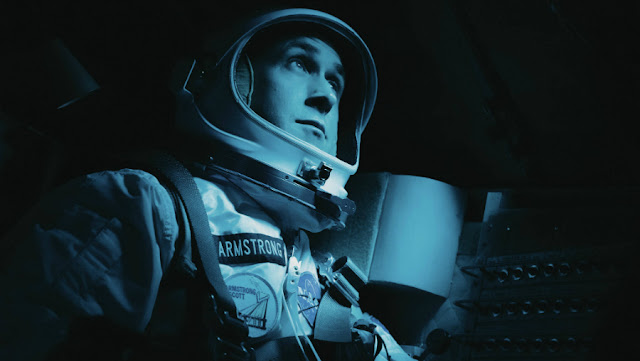
Ryan Gosling in FIRST MAN (Universal (c), still photo by Daniel McFadden)
★ ★ ★ ★ ★

Damien Chazelle makes the hat-trick with this extraordinary film that, appropriately, puts the man first. Ostensibly depicting the trials and tribulations of NASA’s Gemini and Apollo programs, First Man reveals itself to actually be about those of Neil Armstrong, in a refreshing break from space films that are less concerned - thematically, at least - with the inner workings of their central characters (Gravity is about survival, Interstellar is about time, The Martian is about collaboration, and so on).

Armstrong (Ryan Gosling) and his hopes, fears, treasures and turmoil are laid bare years before the dawn breaks on July 16th, 1969. Most are unspoken, all are devastating. The film begins with the death of his young daughter, Karen, and from there explores the near-decade Armstrong and his wife, Janet (Claire Foy) spent in the wake of that tragedy. Neil is concurrently engaged in constant danger, training for the race to reach the moon.

Far from a demonstration as the La La Land director’s new muse, First Man is the ultimate utilisation of Gosling’s best qualities as a restrained performer. His Armstrong speaks softly, withdraws from crowds, and has a crucial lack - if not active avoidance - of patriotic charisma (that cocksure role is taken up by Corey Stoll as Buzz Aldrin). Gosling says everything with a bowed head, an unfocused gaze, two fingers upon a pane of glass.

Though not explicitly stated by anyone on-screen (the 60s produced many revolutions, but open honesty about mental health wasn’t one of them), Neil’s depression is obvious to anyone who recognises that need to stay silent because admitting pain or anguish would make it real. Here’s a portrait of masculinity that flies in the face of everything one is taught from childhood of these supermen who trod amongst the stars.

Not that Armstrong is absolved entirely of blame for his continued distress. Claire Foy provides the crucial (and utterly indelible) voice of the audience as Janet, who desperately attempts to break down her husband’s emotional Faraday cage. In one of many moments of sheer heartbreak, she demands that Neil sit down and explain to their children that his small step may be a one-way trip. The boys reactions are muted, and they go off to bed almost as they would any other night, just as they returned to playing in the garden when an earlier test run briefly leaves their father spinning hopelessly above the Earth.

Because, for them, it’s impossible to truly comprehend what it means when your father tells you he might not come home. But Chazelle ensures we get the picture, with speaker-shattering launch sequences and dizzying Zero-G acrobatics that are second to none. Faces turn blue with unpreventable gasps and teeth are clenched together as though doing so will somehow hold the tenuous screws of the landing craft in place. Immaculate period detail hammers home the cramped, roughshod reality of early space travel like never before.

Production designer Nathan Crowley and special effects house Double Negative are not all that connects First Man to Interstellar (the inescapable benchmark with which all films of this kind must now compete). Justin Hurtwitz’s sonic accompaniment - by turns delicate and unnerving - follows Hans Zimmer’s lead and departs from a classical action score. The cue which heralds the climactic launch of Apollo 11 itself, however, would feel right at home amongst the late James Horner’s score for Apollo 13 (something about a soaring rocket seems to demand such a stirring piece).

Also present is the connection between a father and his unreachable daughter that forms the emotional core: one comes to realise very quickly that Armstrong’s devotion to his mission is so much more a personal quest than a political or occupational one. That this peace comes at the cost of lives, amity between nations and familial upheaval only adds to the burden of a man who just wants to escape the noise of the Earth as he does the din of a White House party.

Chazelle, Gosling and cinematographer Linus Sandgren reward him that, finally, on the largest canvas possible. Painfully intimate 16mm photography gives way to the liberating clarity of IMAX. Neil steps onto a globe all of his own. He - and the audience with him - breathes fully for the first time into a blissful silence. First Man may not end with a bang, but we certainly provide the whimper.

Wednesday, 10 October 2018

"The Greatest Snowman" or: How I Learned To Love Confused Customers

10/10/2018 03:51:00 pm 0
"The Greatest Snowman" or: How I Learned To Love Confused Customers

“Two for the...uh...that one with...” the middle-aged gentleman stood across the till from me turned desperately to his partner, who returned his blank look. I waited. The silence stretched. The queue fidgeted.

“Oh, bloody hell, what’s it called again?” he gesticulated to no-one in particular, before clapping a hand to his forehead. Sighing internally, I scanned my screen for the list of possible titles.

“Insidious 3?”
“No.”
“Three Billboards?”
“No.”
“Darkest Hour?”
“No.”
“All the Money in the World?”
“Yes! The J. Paul Getty one! All the World’s Money! Knew it was something like that.”

When you start working at a multiplex, there’s a lot you prepare yourself for: an unshakeable popcorn smell, complaints about how you need to “take out a mortgage” to afford a cinema trip, and, of course, the usual mental strain that comes with a largely thankless retail job. But one unforeseen difficulty in getting patrons from queueing to viewing is their inability to remember what multimillion-dollar filmmaking exercise they’re donating to in the first place.

For the cinemagoers, they rest comfortably in their assumption that we can translate their request for “That one with Joanna Lumley” into “One for Finding Your Feet?”. For those of us on the other side of the counter it’s occasionally frustrating, but never dull.

The categories for incorrect titles are as manifold as the misnomers themselves, but after a few months, the repeat offenders become obvious: mispronunciation, misinformation and abbreviation.

Mispronunciations from those who count English as a second language are fair play, but from native speakers it’s amusing, if a little worrying. See, for instance, the Christian Bale western, Hostiles, spoken aloud by one Cambridge University student as “Hoss-teal-ezz”. Or, how about that new movie about space wizards, Star Wars Episode VIII, with the roman numerals pronounced as “Veeeee”.

Misinformation depends entirely on one’s exposure to the advertising campaign of the film in question. Despite posters plastered across the sides of buses, adverts playing on television, heavy Oscar buzz and a basis in Blitz-era nostalgia, one late-January release inexplicably proved enormously difficult for British citizens to recall. Thus follows a complete list of wrong labels I received for Joe Wright’s World War 2 drama, Darkest Hour:

The Darkest Hour
Our Darkest Hour
Darkest Night
Heart of Darkness
The Darkness
Hour of Darkness
The Hours
Last Hours
Finest Hour
Their Finest
Churchill
Winston Churchill
The Longest Day

Most forwent any attempt at the correct three syllables and simply asked for “The Winston Churchill one”.

Other marketing mishaps include “Last Call Pitches” (the tagline for Pitch Perfect 3, which enjoyed a larger space on the poster than the actual title) and “Wallace and Gromit” in place of Aardman’s Early Man, a film which sold itself mainly on homegrown affection for the Bristol-based studios original duo.

Abbreviation is where the definite/indefinite articles or any other words deemed extraneous go to die. The former is easily forgivable (also working in reverse, adding “The” to titles that never had one e.g. The King of Thieves). The latter is the most entertaining of all categories, usually reserved for films with unreasonably long names, needless subtitles, chapter numbers and so on. Three Billboards Outside Ebbing, Missouri proved especially popular in this respect. Besides one patron who spoke in a hugely immersive southern drawl, not a single customer bothered to go the whole hog. “Ebbing” was the first to go, followed by “Outside Missouri” (once replaced with exasperation as “Three Billboards in whatever”). By the time its run in UK cinemas was coming to a close, this once prized Best Picture nominee had been reduced to “Billboards”. A personal favourite would be the supremely confident woman who requested a ticket for “Three Billiards”.

But by far the most notable entry here would be (deep breath) The Guernsey Literary and Potato Peel Pie Society. Customers - understandably - had so much trouble getting through all eight words of this twee British confection that many resorted to “The Guernsey Film”, “The Potato one”, or, brilliantly, “The one with the stupid title”.

All this anecdotal evidence might lead one to consider wrong titles a source of irritation for those of us attempting to whittle down a sizeable Friday night queue. With sparse exceptions (such as a customer who repeatedly and angrily denied that he meant to say The Last Jedi when he asked for “The Last IMAX”), the very opposite is true.

Working in hospitality is repetitive, often exhausting and largely unrewarding, so those manning the concessions stand take our small pleasures where we can. Sometimes it’s worth spending seven hours behind a cash register, dashing about to refill endless popcorn bags, just for that one faintly amusing anecdote about the patron who changed the delicate, intriguing A Simple Favour into the more brusque “Do me a favour”.

So next time you arrive at the box office, desperately trying to recall the name of the film you’re about to pay £10.95 to see, don’t fret. No Googling the cast list, no scanning the foyer for a poster, no turning to your date/friend/mother for help; just give it a shot. Whether you leave out the episode number of the latest Star Wars film, mispronounce a foreign title or accidentally fuse the smash hit P.T. Barnum musical with a Michael Fassbender thriller, we’ll help you find your way.


This article was inspired by the writer’s current working experiences in a British cinema, as well as this Letterboxd list: https://letterboxd.com/shawn_stubbs/list/wrong-movie-titles/

Please share your experiences on Twitter, using the hashtag #WrongTitle

Wednesday, 3 October 2018

'Venom' - Review

10/03/2018 02:24:00 pm 13
'Venom' - Review

★ ☆ ☆ ☆ ☆

Here is Sony Pictures' second attempt to build a Marvel universe to rival Disney's (stop laughing, they're deadly serious). Venom - seemingly dumped on our world from a rip in the space-time continuum splicing the year 2005 with the present day - sits comfortably alongside the likes of Elektra, Ghost Rider and Daredevil. Grimdark pretentions? Check. Positioning of protagonist as edgy antihero? Check. Ludicrous rubber costumes? I wish.

Star of the show here is the eponymous blob, a parasitical alien which attaches to a living host and imbues them with superhuman abilities. Venom finds a vehicle in smug, down-on-his-luck journalist, Eddie Brock (a spectacularly miscast Tom Hardy). "You look like shit!" exclaims the owner of Brock's local corner shop, as he swaggers cooly past with hair perfectly styled, sporting just the right kind of stubble and trendier clothes than anyone else within fifty miles.

He's on the trail of billionaire Carlton Drake (Riz Ahmed), a cardboard cutout superviallain obsessed with human-symbiote experimentation. Brock's investigation (assisted by an upsettingly underused Jenny Slate) exposes him to one of the parasites. Hence, Venom - a giant, foul-mouthed monster with a penchant for biting people's heads off - is born.

But before the beast is unleashed, we must suffer an hour of 'Superhero Origin Stories for Dummies', replete with a plodding romance subplot (Hardy and a bored, bewigged Michelle Williams conjure no chemistry), unintelligible action sequences and broiling inner turmoil. At least, that's what one assumes Hardy is going for with his Jim Carrey-esque line in spittle and shrieking.

When the latter half finally sees Venom emerge, things fail to improve. An age rating promising gory ultra-violence is all bark and no bite, with most antagonists dispatched in a blur of swinging tentacles and nondescript crunching sounds. The genuinely enticing body-horror aspects of the comic book source are buried, and the Bronson star's clear commitment to depraved lunacy proves all for naught. 

It's difficult to see loyal fans of the Venom character - still searching for salvation after Spider-Man 3 - getting back on board (incidentally, the producer who insisted upon Venom's involvement in said misfire, Avi Arad, returns to supervise this outing). As a disposable piece of popcorn fodder, it's merely hopeless. As the basis of a major cinematic enterprise, it's poison.

Thursday, 26 July 2018

'Mission: Impossible - Fallout' - Review

7/26/2018 12:04:00 am 0
'Mission: Impossible - Fallout' - Review

★ ★ ★ ★ ½


One doesn’t often clamour to declare a franchise’s sixth instalment its finest hour - unless you happened to be me in the immediate aftermath of Revenge of the Sith - and yet, here we are. Mission: Impossible - Fallout leaves no nail unchewed in its quest to outdo every previous instalment (nay, every action movie released in the last decade) with minimal digital trickery and maximum physical impact.

The plot (largely surplus to the requirement of whichever death wish Tom Cruise fancied living out during that day’s filming) finds Ethan Hunt and company (Cruise, Simon Pegg, Ving Rhames and Rebecca Ferguson) in pursuit of stolen nuclear material. Given Ethan’s propensity for going rogue, he’s lumped with the CIA’s favourite blunt instrument, August Walker (Henry Cavill).

With both the CIA and a shady organisation known as The Syndicate on their tail, how do they intend to do all this? “I’ll figure it out” is the general mantra adopted by Hunt, his put-upon comrades, and director Christopher McQuarrie. And figured it out, he has. Every set piece - whether it’s a motorcycle chase into oncoming traffic in Paris, a rooftop pursuit in London, or an actual HALO jump performed thirty thousand feet in the air - surges with unbelievable adrenaline, each more thrilling than the last. Even in a standard cinema, the IMAX footage (including said skydive) shines brightest of all, the lack of stuntmen in Cruise’s stead laid beautifully bare.

Cruise - who broke his ankle in a comparatively minor stunt, leaping between rooftops (just another day at the office!) - continues to display levels of physical aptitude suited to a man half his age, but his portrayal of Hunt still stands even when removed from the sheer spectacle. With a history such as his, our favourite IMF operative is an understandably twitchy presence who smiles little and frets often, fueled by the desire to prevent nightmares of his lost love, Julia (Michelle Monaghan), from becoming reality.

Cavill, by contrast, is statuesque and supplied with a resolute workman’s grin. Justice League died so his moustache could live, and it proved a necessary sacrifice. Ditching the clean-shaven boy scout look serves him well in a role that seems tailor-made for his physical prowess and roughshod charisma, not least during a furious bathroom showdown that calls to mind the most chest-shattering moments of Gareth Evans’ The Raid 2.

Whilst images crunch the bones, pulses are pounded by Lorne Balfe’s score, which hits the ground running from the opening logos and barely pauses for breath. It’s not packed with memorable cues (the Lalo Schifrin original theme is given some fancy reworks), but Balfe should be commended for his ability to deliver music to match the mayhem.

As is standard practice for the franchise, this entry suffers from a convoluted plot, and works best when it sheds the scheming and puts pedal to metal. McQuarrie and Cruise know that in a post-Mad Max: Fury Road landscape, simplicity is key. With an action sequence involving a fleet of trucks, cars, explosions and flamethrowing guitarists now embedded in the moviegoing consciousness, there’s no further you can go (besides maybe filming the entire thing in outer space). It’s time to go back to basics, and maybe the greatest victory of Fallout is achieving the highest possible stakes with the simplest image: a man clinging to a rope. Your mission, should you choose to accept it, is to survive the final thirty minutes without gripping onto your seat, stuffing your knuckles into your mouth or simply swearing out-loud in disbelief: impossible? I’ll say.

Thursday, 19 July 2018

'Whitney' - Review

7/19/2018 01:58:00 pm 0
'Whitney' - Review


★ ★ ½ ☆ ☆


Like a stone upon the surface of a lake, this documentary detailing the life, labours and loves of pop star Whitney Houston skims close to many truths, but eventually sinks in search of a scoop. Academy award-winning writer-director Kevin MacDonald’s handling of his topic is efficient but oddly heartless: emotional moments (Houston’s famous performance of ‘I Will Always Love You’ in Johannesburg, camera-phone footage of her disastrous comeback tour in 2010), would pack a punch even without the context of the doc’s wider story. Her key chart-toppers are placed by MacDonald and his editor Sam Rice-Edwards into the wider context of America’s various conquests throughout the seventies and eighties and up to the turn of the century, fragmenting the film as it tells the various stages of her story.

Unfortunately, these bookmark montages are emblematic of a wider problem with the film: it’s all about how Whitney’s story unfolded before the world, but never how the world shaped her story or her music. Interviews with various members of her family dig a little deeper into her constant battle with drugs, her sexuality, her family’s background in black gospel singing and what her success meant to that community, but the singer’s own words - already hard to come by, as Houston made very few TV interviews - are notable only by their infrequence. Whitney’s glittering construction and swift pace leaves little room for reflection, with an unedited home video recording of Whitney and her mother, post-performance, serving as the only real pause for thought.

As with Nick Broomfield’s Whitney: Can I Be Me?, perhaps the fault lies with a white British director taking on a subject so inherently tied to the voice of black America in the last decades of the twentieth century. In the case of Kevin MacDonald, we even have a storyteller who, by his own admission, was not fond of Whitney Houston before starting his research and found the whole sorry affair of her death “distasteful”. The whiff of a smoking gun is detected in the air towards the conclusion, but with the Houston family and her closest friends decidedly split about who or what was to blame for her tragic end, it’s a feeble finale.

Thursday, 5 July 2018

'Adrift' - Review

7/05/2018 09:46:00 pm 1
'Adrift' - Review

★ ★ ★ ½ ☆

Two great performances keep Baltasar Kormákur’s latest disaster drama resolutely afloat: Shailene Woodley and Sam Claflin star as real-life couple Tami Oldham and Richard Sharp, whose voyage from Tahiti to San Diego in 1983 took them directly into the path of Hurricane Raymond. The film plays out in a split time-frame, beginning with Tami waking aboard the wrecked vessel, before flashing back to detail their romance, and leading towards a dual finale.

This narrative structure - in sharp opposition to the linear unravelling of Kormákur’s previous film, Everest - contrasts the sun-kissed days of Tami and Richard’s growing connection against the survival thriller of Raymond’s aftermath. Turning up the cheese to reinforce the grit, it results in an incredibly effective sense of gnawing inevitability, always keeping us one match cut away from tragedy.

Woodley has grown a lot as a performer since the Divergent series that made her the household name of teenage audiences (even in rocky fare like Oliver Stone’s Snowden, she acquits herself well), and here she’s as steadfast as we’ve ever seen her. Her performance walks an impressive line between Sandra Bullock in Gravity and - strangely - Jennifer Lawrence in The Hunger Games series: there’s that same grounded aura of rags-to-resolve as Tami deals with the devastation.

Claflin, too, is excellent. His endless charisma is a valuable asset during the scenes of seaborne young love (i.e. he looks good sailing into port with his shirt hanging open), and his ability to switch from wry humour to wan acceptance sees us through the darker moments. Richard was originally to be played by Miles Teller, and (no offence to Teller) I think the film owes a debt of thanks to those “scheduling conflicts”.

What small amount of artistic liberty the film takes is all to do with pathos, as opposed to narrative neatness. As the remainder pays attention rather than lip service to reality (its approach to the logistics of finding oneself shipwrecked would make for a fine double bill with All Is Lost), small fictional reveries can be forgiven. Adrift may not be a note-perfect depiction of a true event, but as a showcase for two stars at the top of their game; it hits all the right ones.

Tuesday, 3 July 2018

'Sicario 2: Soldado' - Review

7/03/2018 02:33:00 pm 0
'Sicario 2: Soldado' - Review

★ ★ ☆ ☆ ☆

Picking up where 2015’s grim tale of murky morals on the Mexican border left off, this sequel finds itself squeezing every political pressure point within reach. Josh Brolin returns as CIA operative Matt Graver, tasked with initiating open warfare between the Mexican cartels to dissuade the smuggling of terrorists across the border. He again enlists the mysterious Alejandro (Benicio Del Toro), this time to kidnap a crime lord’s daughter (Isabela Moner) and thereby escalate the unrest: they're going to build a war and make Mexico pay for it.

With the triple-threat of helmsman Denis Villeneuve, cinematographer Roger Deakins and star Emily Blunt now absent, this descent into destruction loses all direction and grace, becoming - ironically - a rather blunt instrument. I didn’t think Sicario had a heart in the first place, but without Blunt’s Kate Macer as the moral anchor, Soldado becomes a one-way ticket to rock bottom for all parties involved. “Rules of engagement, sir?” asks a squadmate of Graver’s as they prepare for a stand-off. “Fuck it all”, comes the response.

Nowhere is the shrugging off of anything less dour than a Nietzschean tract more apparent than this moment, Graver having already dismissed POTUS as “cowardly” for not wanting to cause the destabilisation of a neighbouring country. Taylor Sheridan returns as screenwriter, and makes it his mission to push all the MAGA era buttons he can before someone pries his fingers from the typewriter. The film opens with Mexican immigrants swarming towards the border, ISIS suicide bombers concealed within their ranks. An entire subplot is dedicated to the training of a young Mexican trafficker (Elijah Rodriguez). Disturbingly realistic dramatisations of atrocities committed on American soil are delivered in clear detail while later images of Mexican children and parents boarding separate buses are casually, even callously dismissed before we move to more masculine brooding.

Sheridan still has problems writing women, too: Kate Macer may have been our way into Sicario, but her feminine traits were unsubtly coded as simply daring to have ideals in the first place, used only as a contrast to the more pragmatic Graver and the morally suspect Alejandro. In Soldado, the only women with substantial speaking roles are Catherine Keener as a hawk-like overseer, and Moner, who's (still magnetic) turn as political prisoner becomes little more than a device to draw out development for Alejandro and plot exposition from everyone else. Del Toro is a gripping presence, as one would expect, but Brolin - bereft of any challenger - simply stomps about with his chin forward.

Director Stefano Sollima (Suburra) is no stranger to underworld unrest, and his teaming up with d.o.p. Dariusz Wolski (Alien: Covenant) makes for some appropriately forbidding imagery. Everything’s either blistering desert sunlight or spotlit shadows, both colour-timed to whichever shade of grey fits the current philosophical mood. Soldado’s nihilism, however (largely displayed in explosive but uninvolving action scenes), becomes wearing all too soon. An epilogue that further hammers home this franchise’s Gospel of Matthew, “violence begets more violence” message offers no solution to its central conflict, nor to the real-life horrors it purports to represent.

'Patrick' - Review

7/03/2018 09:58:00 am 0
'Patrick' - Review

★ ☆ ☆ ☆ ☆


Even by the usual standards of pet-centred pictures, this film of asinine canine antics is one for the pound. Beattie Edmonson is put-upon English teacher Sarah, whose grandmother passes away and leaves the irritable singleton her prized pug, Patrick. Before long, the poop-happy pooch is wrecking her flat, embarrassing her in front of the neighbours and thwarting all attempts for Sarah to be rid of him. The most unbelievable part of an extortionately convoluted plot is that, in the age of sickly viral videos and entire social media campaigns dedicated to them, a pug would be impossible to sell (I’ll bet that somewhere on the cutting room floor lies a scene in which Patrick gets his own Instagram).


And it is a frankly labyrinthine tangle of a story for a (supposedly) cutesy kids movie. Sarah must face a possible eviction, carjacking pupils (who, of course, all look about 25), a rotten family, a fun run, nasty rival teachers, and two possible suitors. They arrive in the form of the frankly awful Ed Skrien and Tom Bennett, both almost unrecognisable beneath pained expressions that exude less “Kiss me” and more “Kill me”. Everyone - Edmonson included - looks like they wish they were somewhere else, while Jennifer Saunders looks like she should be somewhere else, staggering in from the sidelines every now and again to offer everyone cake when she should be offering them criminal compensation.


Patrick, meanwhile, wanders about causing every manner of upset, all carried off with the comic timing of a particularly bad episode of The Chuckle Brothers and the editing skills of a toddler. Impressively, for a film in which the dopey dog single-handedly demolishes Sarah’s apartment, none of his messes ever quite outshine the script itself: a screenplay relying on coincidences so eye-rolling they’d have you throwing up if the dialogue didn’t already. Too tortuous for tots and too cloying for parents, it makes 90 minutes feel like 90 millenia.